

Welcome to Interschool Chakravyuh Challenge
Organized by AMI Shishu Mandir in collaboration with FIZ Robotic Solutions (FRS)
Technical Partner: Techkriti, IIT Kanpur
Invent. Innovate. Inspire. The Interschool Chakravyuh Challenge Awaits!
AMI Shishu Mandir, in collaboration with FIZ Robotic Solutions, proudly presents the Interschool Chakravyuh Challenge – an innovative platform that blends robotics and digital creativity to inspire young minds. This inter-school event aims to foster innovation, problem-solving, and teamwork, while showcasing exceptional talent in both STEM and digital design.
Technical Event Partner: Techkriti, IIT Kanpur
Presented by:
AMI Shishu Mandir Society & FIZ Robotic Solutions
Event Date - 22nd December 2025
Technical Partner: Techkriti, IIT Kanpur
Event Venue - AMI Shishu Mandir, Gwalior
HIGHLIGHTS
Exhibitions
Robotic Events
Interschool Chakravyuh Challenge is more than a competition; it’s an opportunity to nurture the innovators and creators of tomorrow. Be a part of this transformative journey that blends technology with imagination!
Join us for a day of excitement, creativity, and inspiration.
EXHIBITIONS
Ganit Yodha
Grade: VI-VIII
Event Duration: 2.5 Hours
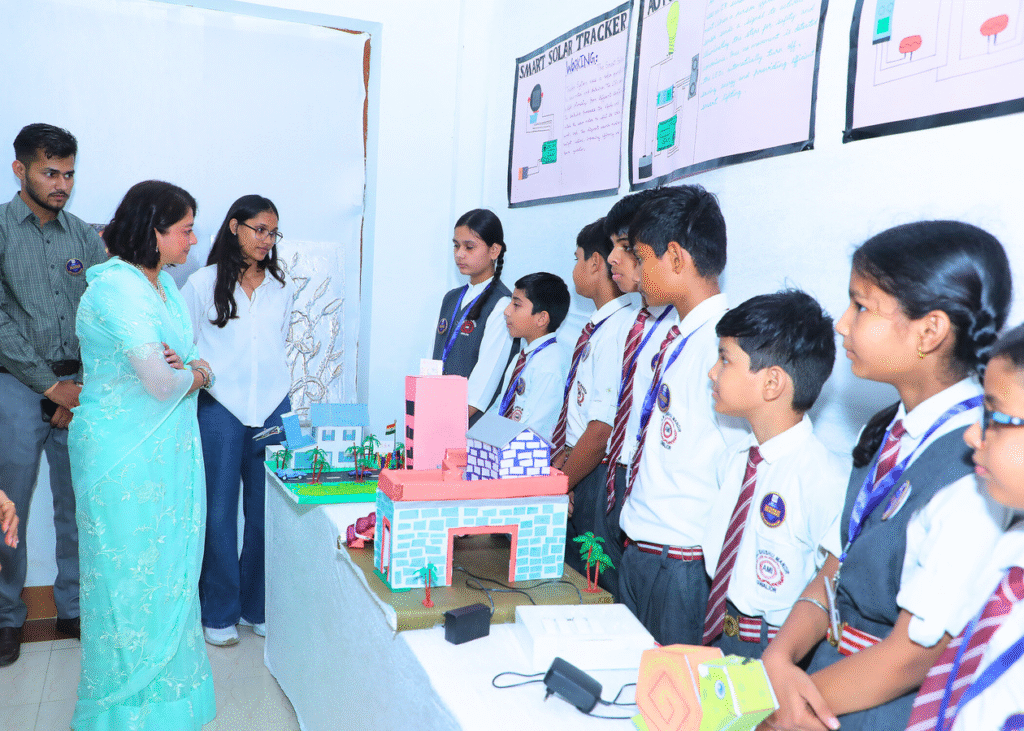
THEME : SPORTS (MODEL MAKING)
Format:
- Participants : Team of 2 students
- Model Allowed : One Per Team/School
- Escort Teachers : One Per Team/School
- Classes : VI-VIII
Rules (Sports Theme + Real-Time Math Calculations):
- Teams will be evaluated on creativity, scientific approach, originality, technical skills, costeffectiveness, presentation quality, and how effectively their working model demonstrates real-time mathematical calculations used to win a sports game.
- Each model must be fully functional and show how maths—such as force, angles, speed, trajectory, timing, and scoring strategy—directly impacts performance in sports.
- Students may use charts to support and explain their calculations and gameplay strategy.
- Each school will be given 30 minutes to set up their model and other requirements.
- Bot Limitation: Each team can field only one bot in the arena.
- Extension cords will not be provided; all models must operate on batteries. Sockets will be available only for charging batteries, not for powering the model continuously.
Example:
- (This example is only for reference and does not need to be followed exactly.) A working billiards model where sensors calculate the exact angle, cue force, rebound path, and collision points needed to pocket a ball. The system displays these calculations in real time, showing how mathematical precision determines every winning shot.
Vigyan Kawach
Grade: IX & XI
Event Duration: 2 Hours
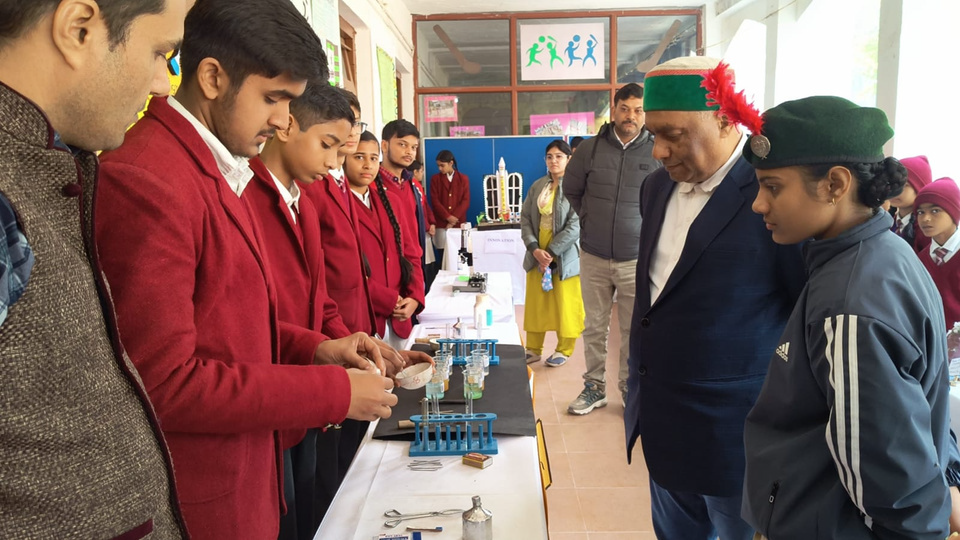
THEME : SPACE AND DEFENCE (MODEL MAKING)
Format:
- Participants : Team of 2 students
- Model Allowed : One Per Team/School
- Escort Teachers : One Per Team/School
Rules:
- Teams will be evaluated on creativity, scientific thinking, originality, technical skills, costeffectiveness, presentation, market ready and how effectively their working model demonstrates real-time scientific principles used in space and defence missions.
- Each model must be fully functional and should clearly showcase scientific concepts such as propulsion, aerodynamics, energy transfer, targeting mechanisms, navigation systems, communication technologies, or surveillance related techniques essential for mission success in space or defence operations.
- Students may use charts to support and explain their calculations and gameplay strategy.
- Each school will be given 30 minutes to set up their model and other requirements.
- Extension cords will not be provided; all models must operate on batteries. Sockets will be available only for charging batteries, not for powering the model continuously.
Example:
- (This example is only for reference and does not need to be followed exactly.) A working model of a missile guidance system where sensors calculate the projectile’s optimal angle, thrust, and trajectory to accurately hit a target. The model displays these calculations in real time, demonstrating how precision maths and navigation are critical in defence missions.
ROBOTIC EVENTS ROBOFEST
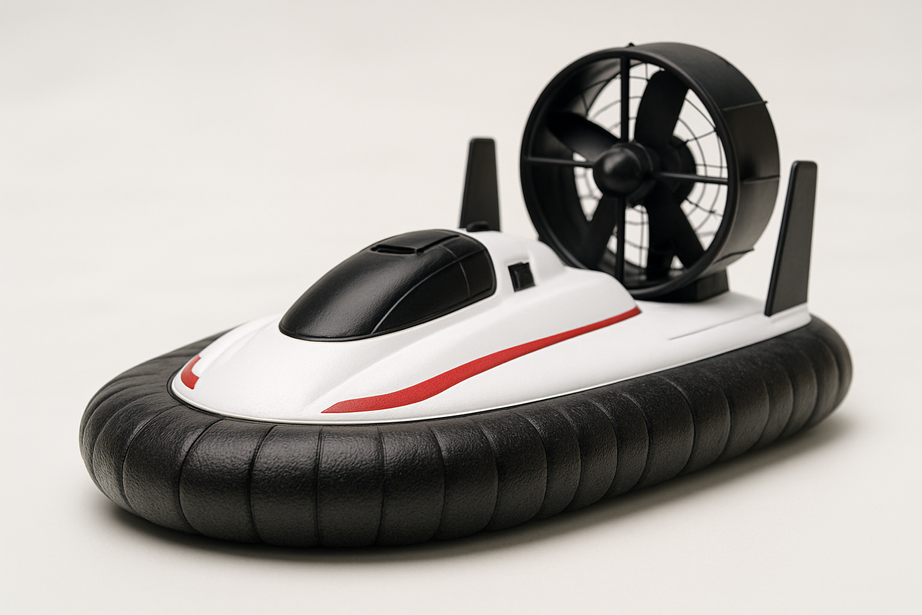
Hoverush
Grade: VI - IX & XI
Event Duration: 2 Hours
Format:
- Hovercraft Design: The hovercraft must be self-built (no readymade/lego kits/3D printed parts will be allowed), a minimum lift height of 3 cm at full throttle. Only electric motors are allowed, and metal propellers are prohibited.
- Match Rules: Teams must follow the track, avoiding penalties for obstacles, human intervention, or deviating from the path.
Rules:
- Team Size: 1-3 students
- Maximum bot dimensions: 50x50x50 cm
- Maximum bot weight: 2 kg
- Operating voltage: Maximum 12V DC
Manoeuvre
Grade: VI - IX & XI
Event Duration: 2 Hours
Format:
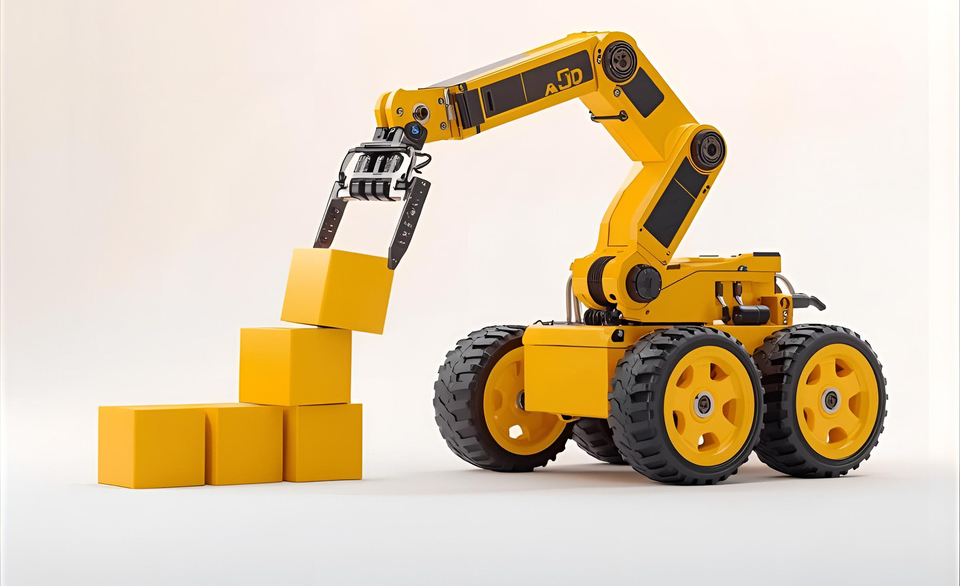
- The bot must be manually controlled and capable of gripping various blocks or shapes. It should be able to insert them into corresponding grooves carved into a cubic block. The gripping mechanism should be precise and able to handle various shapes securely. The bot should be completely hand-made, no ready made/lego chassis will be allowed.
- The bot can be either wired or wireless. Wireless control options include a dualfrequency remote, Bluetooth, or Wi-Fi.
- The bot should be able to precisely align and place the blocks into their respective grooves, requiring accurate control of its movements and gripping mechanism.
- For wireless bots, ensure the control mechanism provides a stable connection and sufficient range to operate effectively within the task area without any interference or lag.
Rules:
- Team Size: 1-3 students
- Maximum bot dimensions: 50x50x50 cm
- Maximum bot weight: 2 kg
- Operating voltage: Maximum 24V DC
Battle of Balloons
Grade: VI - IX & XI
Event Duration: 2 Hours
Format:
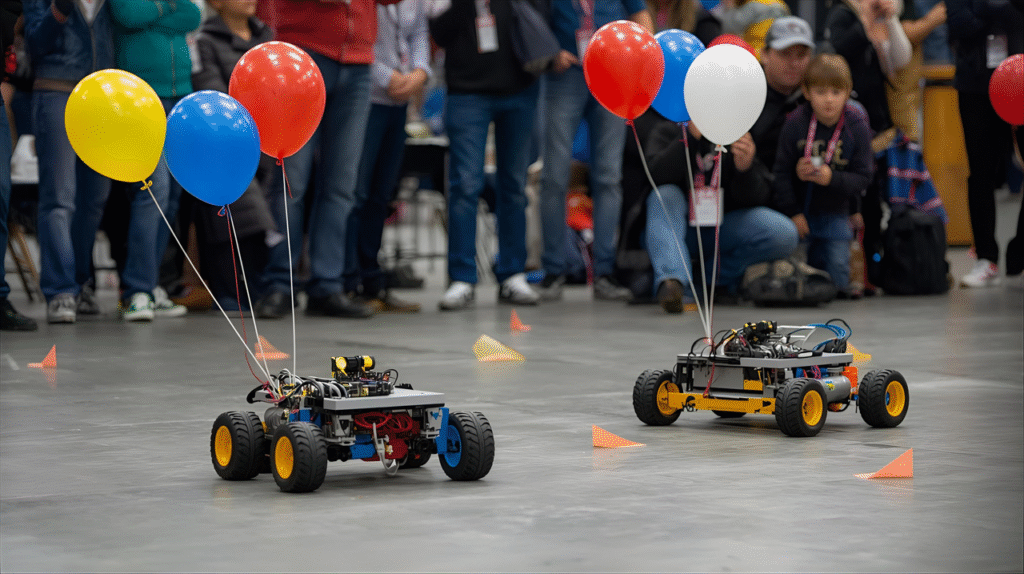
- Teams compete in an exciting bot battle where each bot carries a balloon attached to its side. The objective is to defend your own balloon while attempting to burst your opponents’ balloons using offensive mechanisms.
- All bots will be lined up inside the battle arena, and the last bot with an intact balloon will be declared the winner.
- Bots can be controlled using wired or wireless remote systems.
- Use of ready-made/LEGO chassis or grippers is strictly prohibited.
- Bots must be equipped with non-destructive mechanisms — any design intended to cause structural damage will lead to disqualification.
Rules:
- Team Size: 1–3 students
- Maximum Bot Dimensions: 50 x 50 x 50 cm
- Maximum Bot Weight: 3 kg
- Operating Voltage: Maximum 12V
- Bot Limitation: Each team can field only one bot in the arena.
- Mechanisms: Only safe and non-destructive popping mechanisms (like pins, needles, or spikes) are allowed.
- Balloon Placement: Balloons must be placed on the perimeter of the bot as instructed by the event coordinators before the match begins.
- Disqualification: Any act of human interference or intentional damage beyond balloon popping will lead to immediate disqualification.
- Victory Condition: The last standing bot with its balloon unpopped wins the Battle of Balloons!
Flying Machine
Grade: VI - IX & XI
Event Duration: 2 Hours
Format:
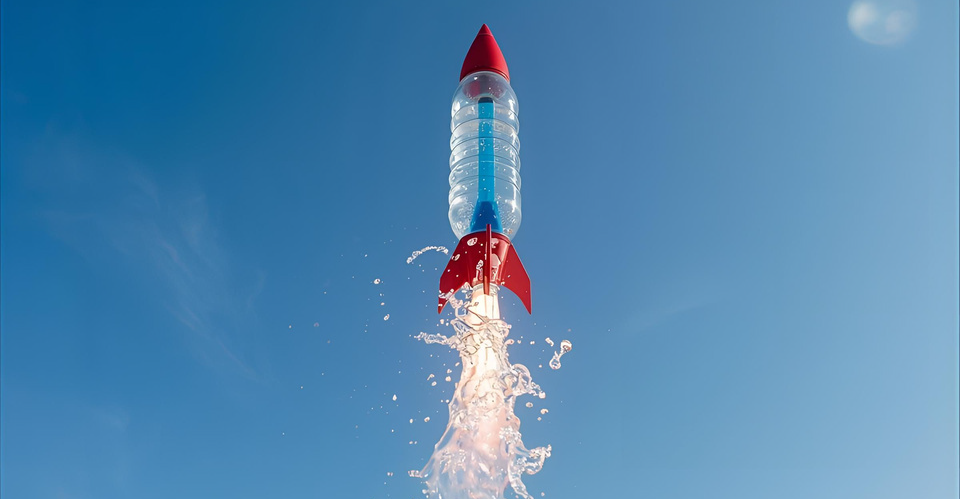
- Participants must design a single stage water rocket to achieve maximum distance and accuracy. The competition will have two rounds.
- Each team gets two launch attempts per round.
- Team of only 1-3 students are allowed to participate.
Rules:
- Rockets must not exceed 2L in capacity.
- Only water and compressed air can be used as propellants.
- Safety measures (e.g., proper assembly and handling) must be followed.
- Launcher has to be fabricated by the teams individually, sharing of launcher is prohibited. Teams making their own hand made launchers will be rewarded with bonus points.
- Manual and electronic pumps are permitted in the event; however, teams must bring their own. The organizer will not provide launchers or pumps to any team.
General Rules
General Terms & Conditions
How to Register
Make sure to register before the deadline!
Key Dates
What is Computer Carnival (C²) 2025?
Computer Carnival 2025 is the 19th annual interschool technology fest organized by Puranchandra Vidyaniketan under the PCVN Information Technology Society, in collaboration with FIZ Robotic Solutions and Techkriti, IIT Kanpur. It’s a celebration of innovation, coding, robotics, and creativity.
When and where will the event take place?
The event will be held on Saturday, 22nd November 2025, at Puranchandra Vidyaniketan, Hemat Vihar, Barra 2, Kanpur, U.P. – 208027.
Who can participate in the Computer Carnival?
Students from Classes IX to XII are eligible to participate in the main events — including Computer-Based, Robotics, Aerofest, and Entrepreneurship categories.
How many participants can each school send?
Each school can send a maximum of 14 students and 1 teacher escort to represent their institution in different events.
How can students register for the event?
All participants must register via the official Google Form before 15th November 2025.
Link: https://forms.gle/oeNXioAuFP2VxuFN7
What are the main categories of events?
The carnival includes three major domains:
- Computer-Based Events (Webscrapers, Hardcoder, Pixel Perfect, Tech Trivia, etc.)
- Robotics Events (Robofest: Nitro Bot, Robo Soccer, Wrestle Mania, Manoeuvre)
- Aerofest (Rocket Masters, Glide-X)
- National Entrepreneurship Fest (NEF 2.0 – Kanpur Chapter)
Is participation in robotics or aeromodelling compulsory?
Yes. Participation in either Robofest or Aerofest is mandatory for all schools. However, participants may choose to compete in both.
What is the reporting time for participants?
All teams must report at 8:00 AM on the event day, 22nd November 2025, for registration and the inaugural ceremony.
What are the rules regarding gadgets and mobile phones?
Students are not allowed to use mobile phones, unless specifically required for a particular event. Any misuse may result in disqualification.
Are there any specific technical requirements for robotics events?
Yes. Robots must follow the dimension and voltage limits mentioned in the brochure (e.g., maximum 30x30x30 cm, 24V DC). Participants must bring their own batteries and components — no AC/DC supply will be provided.
What safety measures are required for Aerofest?
Participants must follow all safety protocols while designing and launching rockets or gliders. Only water and compressed air can be used as propellants, and teams must bring their own pumps and launchers.
What is NEF 2.0 (Kanpur Chapter)?
NEF 2.0 is the National Entrepreneurship Fest, where students present their innovative business ideas in a PowerPoint format. It’s divided into two groups — Grades 6–8 and Grades 9–12 — and judged on creativity, feasibility, and presentation.
What are the judging criteria for the events?
Events will be judged on criteria such as creativity, innovation, problem-solving, accuracy, and technical execution. Judges’ decisions will be final and binding.
Will lunch or refreshments be provided?
Yes, the event schedule includes a lunch break from 1:00 PM to 2:00 PM, followed by the Valedictory Ceremony and Prize Distribution.
Whom should we contact for queries?
For any event-related queries:
Computer-Based Events:
Mr. Devendra Singh Yadav – +91 9336251298
Robotics Events (PARC):
Mrs. Usha S. Yadav – +91 9005300164
Student Coordinators:
Arjun Dixit – +91 9569919670
Sristi Uttam – +91 8188980155