Composite Skill Lab
Composite Skill Lab Setup for CBSE Schools
A Complete Guide to CBSE Requirements, Skill Sectors, Infrastructure, Implementation & FIZ Robotic Solutions
The future of education is moving beyond textbooks and examinations. Students need opportunities to build, experiment, create, solve problems and apply what they learn to real-world situations.
To support this shift, the Central Board of Secondary Education (CBSE) has introduced the Composite Skill Lab (CSL) framework for schools, aligned with the vision of NEP 2020 and the National Curriculum Framework for School Education (NCF-SE) 2023.
A Composite Skill Lab is designed to provide students with meaningful, hands-on exposure to multiple skill areas within a structured school environment.
For schools, this is more than setting up another laboratory. It is an opportunity to create a future-ready learning ecosystem where students can explore technology, vocational skills, innovation and emerging career pathways.
FIZ Robotic Solutions (FRS) helps schools plan, establish and operationalize technology-driven Composite Skill Labs with infrastructure, equipment, curriculum, training and continuous academic support.
What Is a Composite Skill Lab?
A Composite Skill Lab is a multidisciplinary practical learning space where students can develop skills through hands-on activities, projects and real-world applications.
Unlike a conventional subject-specific laboratory, a Composite Skill Lab brings multiple skill areas together and allows schools to create a broader learning environment.
The latest CBSE guidelines recommend that schools identify skill subjects according to their local context, available resources, student interests and opportunities for industry exposure. The selected subjects should collectively address the three forms of work identified in the framework: Life Forms, Machines & Materials, and Human Services.
For technology-focused schools, this creates an opportunity to introduce students to areas such as:
Artificial Intelligence
Robotics & Automation
Electronics & Embedded Systems
Coding & Computational Thinking
Internet of Things (IoT)
3D Printing & Product Design
AR/VR & Digital Technologies
Drone & Aeromodelling
Design Thinking & Innovation
Entrepreneurship
Sustainability and emerging technologies
The exact combination can be selected according to the school's requirements and the skill subjects it intends to offer.
Is a Composite Skill Lab Mandatory for CBSE Schools?
Yes.
According to CBSE Circular No. Skill-13/2026, issued on 20 March 2026, Composite Skill Labs are a mandatory requirement for schools seeking fresh CBSE affiliation. Existing CBSE-affiliated schools are required to establish a Composite Skill Lab with the necessary equipment and machinery by 22 August 2027.
The CBSE framework provides two infrastructure options:
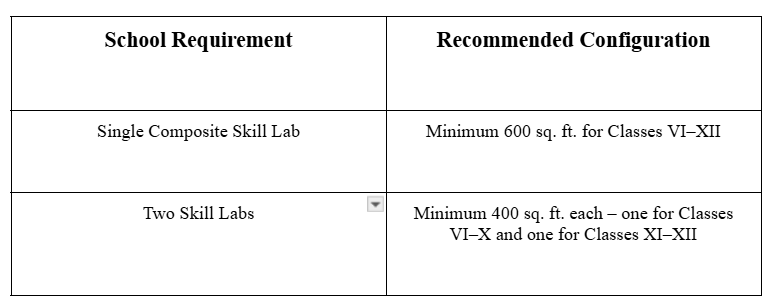
CBSE's guidelines also emphasize safety, accessibility, adaptability, appropriate infrastructure and technology integration within the lab.
What Skill Areas Can Be Offered in a Composite Skill Lab?
One of the biggest advantages of a Composite Skill Lab is flexibility.
Schools can select skill subjects based on their students, infrastructure, teachers, local ecosystem and future career opportunities.
Artificial Intelligence & Robotics
Students can learn the fundamentals of robotics, automation, artificial intelligence, machine learning and intelligent systems through practical projects.
Electronics & Embedded Systems
Students can explore circuits, sensors, microcontrollers, automation systems and electronic product development.
Coding & Computational Thinking
From block-based programming to Python and application-oriented coding, students can develop logical thinking and computational problem-solving skills.
Internet of Things
Students can understand how connected devices collect, process and exchange information through practical IoT projects.
3D Printing & Product Design
Students can move from an idea to a prototype by learning basic CAD, 3D modelling, design thinking and additive manufacturing.
AR/VR & Emerging Technologies
Immersive technologies can help students understand complex concepts while introducing them to emerging digital career pathways.
Aeromodelling, Drones & Aerospace
Students can explore flight principles, aircraft design, drones, propulsion systems and aerospace applications through age-appropriate practical activities.
Innovation & Entrepreneurship
Students can identify real-world problems, develop solutions, create prototypes and understand how ideas can evolve into products or entrepreneurial opportunities.
FRS can help schools select a combination of skill areas that creates a balanced, technology-driven and future-ready Composite Skill Lab.
What Infrastructure Does a Composite Skill Lab Need?
Setting up a successful Composite Skill Lab requires more than purchasing equipment.
The space should be planned around how students will actually learn and work.
Important considerations include:
Appropriate lab size
Workstations and practical work areas
Electrical infrastructure
Internet connectivity
Ventilation and lighting
Storage facilities
Safety equipment
Display and project areas
Tools and machinery
Computers and technology infrastructure
Flexible furniture
Activity and collaboration zones
CBSE's latest guidelines specifically highlight infrastructure readiness, lab design, tools and furniture, safety provisions and appropriate space planning as important stages of implementation.
How FIZ Robotic Solutions Can Set Up Your Composite Skill Lab
At FIZ Robotic Solutions, we believe that a successful skill lab should not become a room filled with unused equipment.
It should become an active learning environment where students regularly learn, build, experiment and innovate.
Our Composite Skill Lab model can cover the complete implementation cycle.
1. Requirement & School Assessment
We begin by understanding the school's:
Available space
Student strength
Classes and grades
Existing laboratories
Existing ATL/technology infrastructure
Skill subjects of interest
Available teachers
Budget
Long-term objectives
This helps us recommend a lab model suited to the school rather than offering a one-size-fits-all package.
2. Composite Skill Lab Design & Planning
FRS can help schools plan the physical learning environment, including:
Workstations
Equipment placement
Project zones
Electronics areas
Robotics areas
Coding/AI stations
Prototyping areas
Storage
Safety arrangements
Student movement and collaboration areas
The objective is to create a lab that is functional, flexible and student-friendly.
3. Technology & Equipment
FRS can provide the required learning infrastructure and practical resources for selected technology-oriented skill sectors.
Depending on the school's chosen sectors, this may include:
Robotics kits
Arduino and embedded systems
Sensors and electronic components
AI learning resources
Coding platforms
IoT equipment
3D printers
Prototyping tools
Drone and aeromodelling equipment
STEM project kits
Computing infrastructure
Innovation and design-thinking resources
Equipment selection should be based on the school's actual curriculum and student requirements rather than simply filling the lab with hardware.
4. Curriculum & Project-Based Learning
A Composite Skill Lab becomes valuable when students actually use it.
FRS can provide structured, practical learning experiences using approaches such as:
Activity-Based Learning + Project-Based Learning + Experiential Learning
Students can progress from:
Learn → Experiment → Build → Test → Improve → Present
This encourages students to apply concepts rather than simply memorizing them.
5. Grade-Wise Learning Pathways
FRS can help schools create progressive learning journeys so that students are not repeatedly taught the same basic concepts every year.
For example:
Middle School
Fundamentals → Exploration → Basic Projects
Secondary School
Advanced Concepts → Integrated Projects → Prototyping
Senior Secondary
Advanced Applications → Innovation → Career Exposure → Entrepreneurship
This allows the lab to grow with the student.
6. Teacher Training
Infrastructure alone cannot create a successful skill program.
Teachers need confidence in using the equipment and delivering practical activities.
FRS can support schools through structured teacher training covering:
Equipment handling
Robotics
Electronics
Coding
AI
Project implementation
Classroom management during practical sessions
Safety procedures
Project evaluation
The objective is to build an ecosystem where teachers can increasingly facilitate practical learning.
7. Dedicated Mentorship & Academic Support
For schools that require additional academic support, FRS can provide trained mentors to support practical sessions and student projects.
This helps bridge the gap between:
Equipment → Curriculum → Classroom Implementation
8. Student Projects & Innovation
Students should leave the lab with something they have created—not simply something they have studied.
FRS can facilitate projects involving:
Robotics
Smart automation
AI applications
IoT
Electronics
Environmental solutions
Assistive technology
Smart transportation
Drones
Aerospace concepts
Sustainable technology
Projects can also be showcased during school exhibitions, innovation fairs and competitions.
Key Benefits of a Composite Skill Lab with FIZ Robotic Solutions
Builds Future-Ready Skills
Students get practical exposure to technologies that are increasingly relevant across industries.
Converts Theory Into Practice
Students learn concepts by applying them to projects, experiments and real-world problems.
Develops Problem-Solving Ability
Students learn to identify problems, test solutions, analyse failures and improve their designs.
Encourages Creativity & Innovation
A well-designed lab gives students the freedom to experiment and turn ideas into working prototypes.
Strengthens STEM Learning
Students can connect mathematics, science, technology and engineering through interdisciplinary projects.
Introduces Students to Emerging Careers
Exposure to AI, robotics, coding, IoT, aerospace and other technologies can help students understand potential future career pathways.
Develops Collaboration & Communication
Students can work in teams, divide responsibilities, document their work and present their solutions.
Encourages Entrepreneurship
Students can progress from identifying a problem to developing a prototype and thinking about its real-world application.
Supports Experiential Learning
Students learn by doing, making the learning process more engaging and meaningful.
Creates a Technology-Rich School Environment
A Composite Skill Lab can become a central innovation space where students from different grades participate in practical activities.
Supports NEP 2020's Skill-Based Education Vision
The CBSE Composite Skill Lab initiative itself is designed to strengthen practical competencies and bridge the gap between conceptual learning and application. CBSE highlights industry relevance, career exploration and entrepreneurial capabilities among the intended outcomes of skill education.
Provides a Structured Long-Term Program
Instead of conducting occasional robotics or STEM workshops, schools can establish a structured skill-learning ecosystem that operates throughout the academic year.
Why Choose FIZ Robotic Solutions?
A Composite Skill Lab should not be treated as a simple infrastructure purchase.
The real value comes from what happens after the lab is installed.
FRS brings together technology, practical education and structured mentorship to help schools build an ecosystem around the lab.
End-to-End Implementation
From planning and infrastructure to curriculum, equipment, training and academic support, FRS can support schools throughout the implementation journey.
Practical-First Learning
Our approach focuses on learning through activities, projects, experimentation and problem-solving rather than only theoretical instruction.
Multi-Technology Exposure
FRS's experience across robotics, AI, electronics, coding, aeromodelling and other emerging technologies enables schools to create a broader technology-learning ecosystem.
School-Specific Solutions
Every school has different infrastructure, students and objectives. FRS can develop the lab model according to the school's requirements.
Student-Centric Learning
The lab is designed around student participation—students build, test, modify and present their work.
Continuous Academic Engagement
The objective is to keep the lab active throughout the academic session through structured curriculum, projects, mentoring and innovation activities.
Competition & Innovation Exposure
Students can be encouraged to participate in exhibitions, challenges, competitions and innovation-focused events, giving them opportunities to demonstrate their skills beyond the classroom.
Composite Skill Lab Implementation Process
FRS can follow a structured implementation journey:
Step 1 — School Consultation
Understand the school's objectives, students, infrastructure and requirements.
Step 2 — Space Assessment
Evaluate the available space and determine the most appropriate lab configuration.
Step 3 — Skill Sector Selection
Identify suitable skill areas based on school requirements, student interest and available resources.
Step 4 — Lab Design
Develop the proposed layout, work zones, equipment requirements and safety arrangements.
Step 5 — Infrastructure & Equipment
Install the required furniture, tools, technology and practical learning resources.
Step 6 — Curriculum Deployment
Introduce a structured grade-wise curriculum and project pathway.
Step 7 — Teacher Training
Train teachers and academic staff to effectively conduct practical learning.
Step 8 — Student Implementation
Begin hands-on activities, projects and practical sessions.
Step 9 — Monitoring & Support
Provide ongoing academic and technical support to ensure effective utilization.
Step 10 — Innovation & Showcase
Encourage students to present projects through exhibitions, competitions and innovation events.
What Makes a Successful Composite Skill Lab?
A successful lab is not measured by the number of machines inside it.
It is measured by:
How many students use it.
How often they use it.
What they build.
What problems they solve.
What skills they develop.
And ultimately:
How confidently they can apply those skills in the real world.
That is the approach FIZ Robotic Solutions aims to bring to Composite Skill Lab implementation.
Continue exploring
Comments