Composite Skill Lab
Composite Skill Lab vs Atal Tinkering Lab: What’s the Difference?
Schools across India are increasingly investing in practical, technology-driven learning environments. Two terms that frequently appear in this space are Composite Skill Lab (CSL) and Atal Tinkering Lab (ATL).
Although both promote hands-on learning and innovation, they are not the same type of initiative. Their objectives, scope, implementation framework, and role within a school can differ significantly.
For school leaders considering a new skill-development facility, understanding this difference is important before planning the infrastructure.
What is a Composite Skill Lab?
A Composite Skill Lab (CSL) is a multidisciplinary skill-learning facility designed to provide students with practical exposure to different skill subjects and vocational areas.
CBSE introduced its Composite Skill Lab initiative in 2024, stating that CBSE-affiliated schools should establish a Composite Skill Lab with the necessary equipment and machinery to support the practical implementation of NEP 2020 and the National Curriculum Framework for School Education. CBSE specified either one 600 sq. ft. lab for Classes VI–XII or two 400 sq. ft. labs for Classes VI–X and XI–XII.
The broader objective is to connect students with practical skills, industry-oriented learning, career pathways and hands-on experiences.
A CSL can therefore function as a structured skill-development environment within the school's academic ecosystem.
What is an Atal Tinkering Lab?
An Atal Tinkering Lab (ATL) is an innovation and tinkering workspace established under the Atal Innovation Mission (AIM) of NITI Aayog.
Its primary objective is to foster curiosity, creativity, innovation, design thinking and problem-solving among students. ATLs provide students with opportunities to work hands-on with technologies such as electronics, robotics, sensors, microcontrollers, 3D printers and computers.
The emphasis is on enabling students to ideate, experiment, prototype and develop innovative solutions.
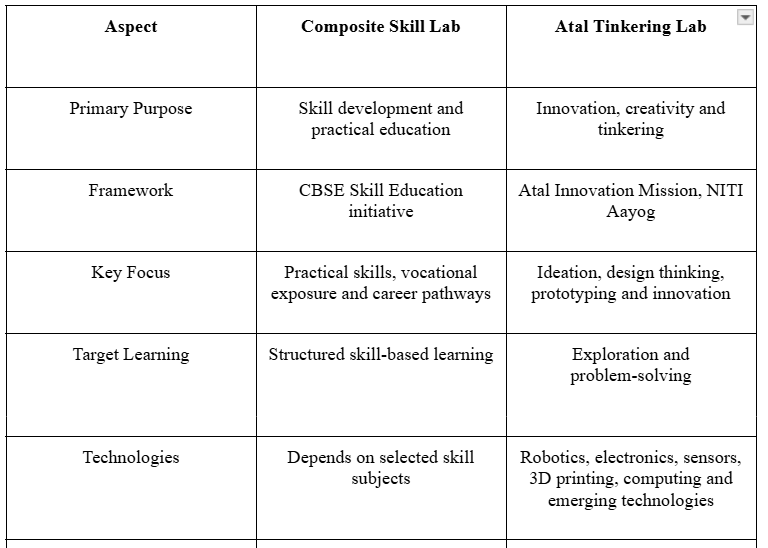
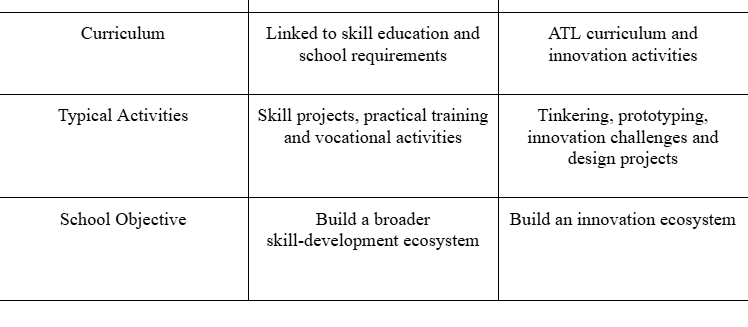
Composite Skill Lab vs Atal Tinkering Lab
The simplest way to understand the difference is:
CSL = Structured Skill Development
ATL = Innovation and Tinkering
However, there is considerable overlap between the two.
1. Difference in Purpose
The most important difference lies in their core purpose.
A CSL is designed to strengthen skill education and practical exposure. It enables students to explore different skills and understand their practical and career applications.
An ATL, on the other hand, is primarily an innovation workspace. Its focus is to encourage students to identify problems, generate ideas and develop solutions through tinkering and experimentation.
2. Difference in Learning Approach
CSL generally follows a more structured and skill-oriented approach.
Students can learn a particular skill through guided activities, projects and practical applications.
ATL learning is comparatively more exploratory. Students are encouraged to experiment with tools and technologies and develop their own ideas.
AIM describes ATL as a workspace where students can give shape to ideas through hands-on, do-it-yourself activities.
3. Difference in Technology and Equipment
There is significant overlap in the technologies used by both facilities.
For example, both can incorporate:
Robotics
Electronics
Sensors
Coding
3D Printing
Microcontrollers
IoT
Artificial Intelligence
However, the purpose behind using these technologies can be different.
In an ATL, these tools are primarily used for tinkering, experimentation and innovation. In a CSL, they can form part of a broader skill-development curriculum.
4. Can a School Have Both?
Yes.
In fact, schools do not necessarily need to view CSL and ATL as competing facilities.
An ATL can strengthen the school's innovation and ideation ecosystem, while a CSL can provide a broader platform for structured skill development.
The two can complement each other when their infrastructure, curriculum and activities are planned effectively.
CBSE and AIM have also explored ways to integrate tinkering and innovation ecosystems within schools.
How FIZ Robotic Solutions Can Support Both Ecosystems
For schools looking to build a modern practical-learning environment, FIZ Robotic Solutions (FRS) focuses on integrating technology, curriculum, projects and mentoring rather than treating a lab as simply an equipment installation.
Through the FIRE Robotics Lab (FRL), FRS can help schools develop a structured environment for Robotics, Artificial Intelligence, Electronics, Coding, 3D Printing, IoT and project-based learning.
FRL can also complement a school's existing ATL by providing additional structured learning, projects and mentoring.
This creates a broader ecosystem where:
Students learn → Students experiment → Students build → Students solve → Students innovate
Which One Should Your School Choose?
The answer depends on the school's objective.
If the primary objective is to establish a structured skill-development facility aligned with CBSE's skill education framework, a Composite Skill Lab should be considered.
If the primary objective is to create a dedicated environment for innovation, tinkering, ideation and prototyping, an ATL is designed for that purpose.
For schools that already have an ATL, establishing a CSL can provide an opportunity to expand beyond innovation activities into a broader skill-development framework.
For schools planning their future-ready infrastructure from the beginning, integrating both approaches can create a stronger ecosystem for practical learning.
Conclusion
A Composite Skill Lab and an Atal Tinkering Lab serve different but complementary purposes.
A CSL focuses more broadly on skill development, practical education and exposure to career-oriented skills, while an ATL focuses on innovation, tinkering, creativity and problem-solving.
The important question for schools is therefore not simply “Which lab is better?” but rather:
“What kind of learning ecosystem do our students need?”
With the right infrastructure, curriculum and mentoring, schools can use CSL, ATL and FIRE Robotics Lab initiatives together to create a practical, technology-enabled environment where students develop the skills to understand, build and innovate.
FIZ Robotic Solutions (FRS) supports schools in building such future-ready learning ecosystems through its FIRE Robotics Lab (FRL) and integrated STEM and skill-development approach.
Continue exploring
Comments