
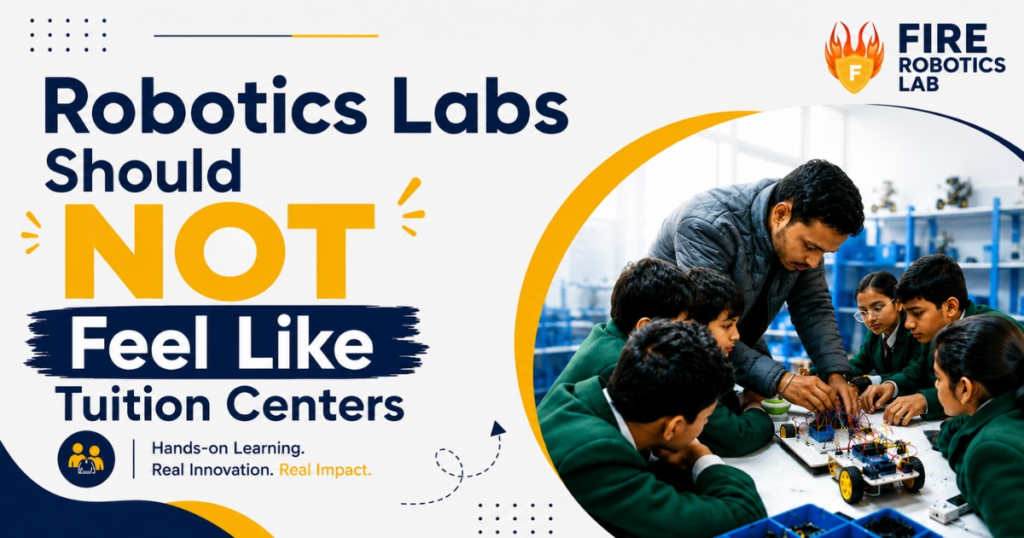
The Future of STEM Education Lies Beyond Instructions
Walk into many school robotics labs today, and you may notice something surprising: students sitting in rows, following step-by-step instructions, completing identical projects, and waiting for the next set of directions.
If that sounds familiar, there is an important question every school leader should ask:
Is this a Robotics Lab, or just another tuition center with electronic components?
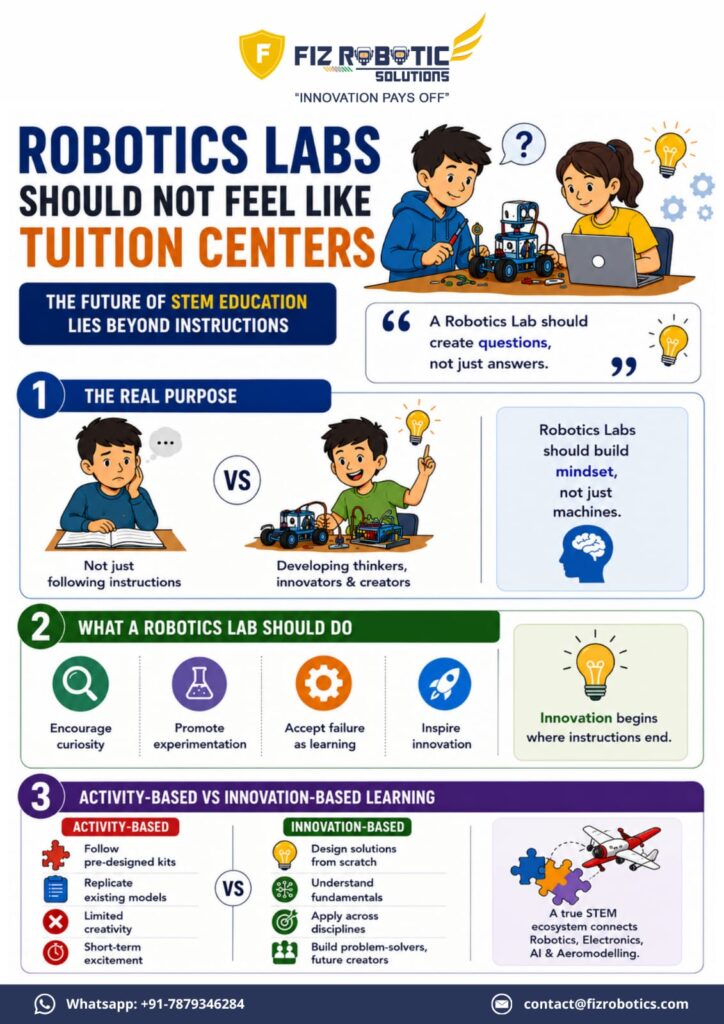
The purpose of a Robotics Lab was never to create students who can simply follow instructions. Its purpose is to develop thinkers, innovators, problem-solvers, and future creators.
In an era where Artificial Intelligence (AI), Automation, Electronics, and Emerging Technologies are transforming industries, schools must rethink what a successful STEM learning environment truly looks like.
A Robotics Lab Should Create Questions, Not Just Answers
Traditional learning often rewards students for finding the correct answer.
A modern Robotics Lab should reward students for asking better questions.
- Why does this circuit fail?
- How can we improve this design?
- Can this robot solve a real-world problem?
- What if we build it differently?
When students are encouraged to experiment, fail, redesign, and innovate, learning becomes meaningful.
The objective is not to build a robot.
The objective is to build a mindset.
“Innovation begins where instructions end.”
The Difference Between Activity-Based Learning and Innovation-Based Learning
Many institutions invest in Robotics programs that focus heavily on assembling pre-designed kits.
While such activities create excitement initially, they often limit creativity because students are merely replicating existing models.
Innovation-based learning follows a different approach.
Instead of asking students to copy a project, it challenges them to:
- Design solutions from scratch
- Understand the fundamentals behind every component
- Apply concepts across multiple disciplines
- Think critically about real-world challenges
A true STEM ecosystem integrates Robotics, Electronics, AI, and Aeromodelling into a connected learning journey rather than treating them as isolated activities.
This approach helps students understand not only how technology works but also why it works.
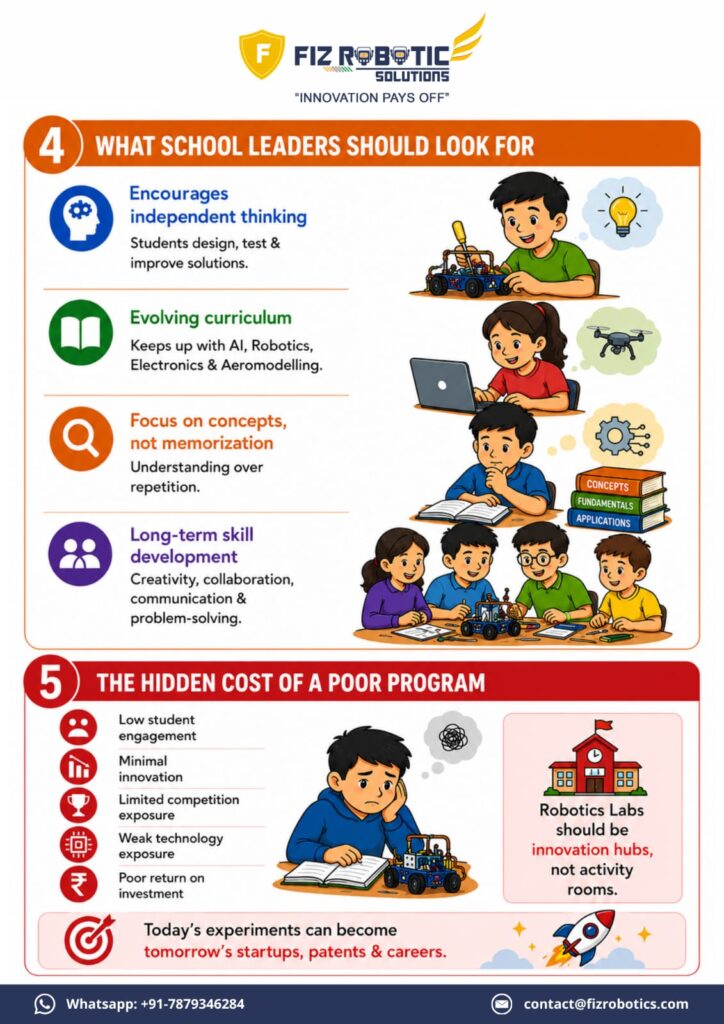
What School Leaders Should Look for in a Robotics Lab
Before implementing a Robotics Lab setup at your campus, it is important to evaluate whether the program encourages genuine learning.
Consider the following indicators:
Does the lab encourage independent thinking?
Students should be designing, testing, and improving solutions rather than simply following manuals.
Does the curriculum evolve with technology?
Emerging fields such as AI, Robotics, Electronics, and Aeromodelling require continuous innovation.
Are students learning concepts or memorizing processes?
A strong STEM program focuses on understanding rather than repetition.
Is the focus on long-term skill development?
- Future-ready students need creativity, collaboration, communication, and problem-solving abilities.
- The Hidden Cost of a Poor Robotics Program
- Many schools focus only on the initial investment while evaluating a Robotics Lab.
- However, the real cost is often invisible.
A poorly designed Robotics Lab can lead to:
- Low student engagement
- Minimal innovation
- Limited participation in competitions
- Weak technology exposure
- Reduced return on educational investment
The most successful schools view Robotics Labs as innovation hubs rather than activity rooms.
They understand that today’s experiments can become tomorrow’s startups, patents, research projects, and careers.
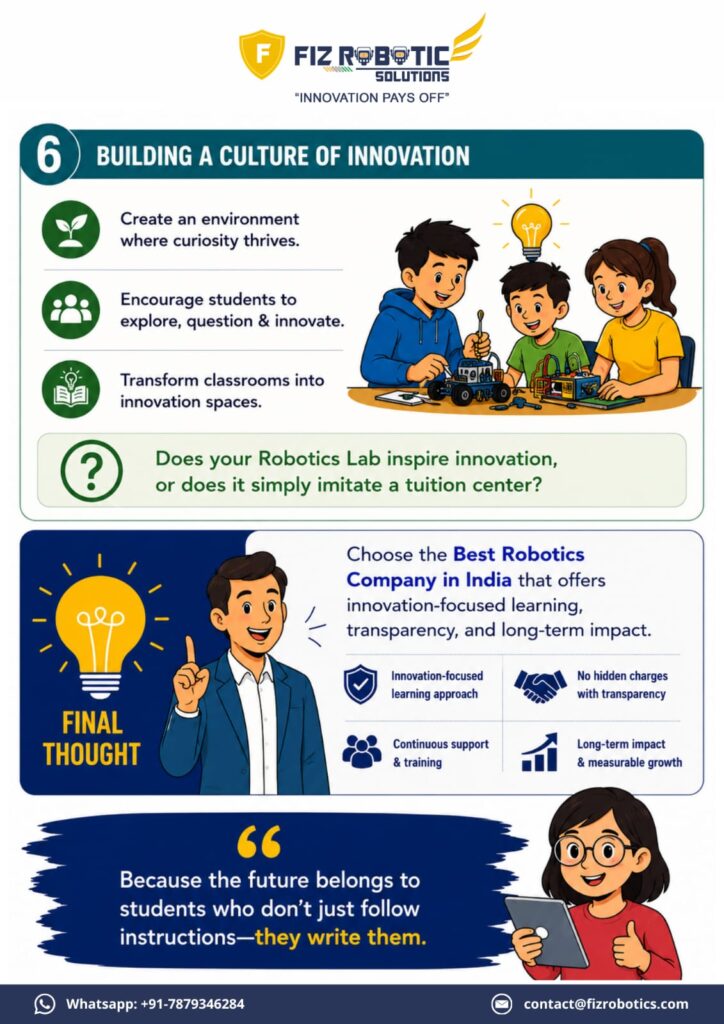
Building a Culture of Innovation
The schools that will lead the next decade are not necessarily those with the most advanced infrastructure.
They will be the schools that create environments where curiosity thrives.
A well-designed STEM ecosystem encourages students to explore, create, question, and innovate.
It transforms classrooms into innovation spaces and students into future-ready learners.
The conversation should no longer be about whether schools need Robotics Labs.
The real question is:
“Does your Robotics Lab inspire innovation, or does it simply imitate a tuition center?”
As educational institutions prepare students for a rapidly changing world, the answer to that question may define the future of learning itself.
Final Thought
When evaluating the Best Robotics Company in India for your school’s technology initiatives, look beyond equipment and project kits. Focus on educational philosophy, transparency, and long-term impact.
After all, schools deserve learning ecosystems that foster innovation, offer clarity with no hidden charges while setting up Robotics Lab programs, and empower students to become creators of technology rather than consumers of it.
Because the future belongs to students who don’t just follow instructions—they write them.