
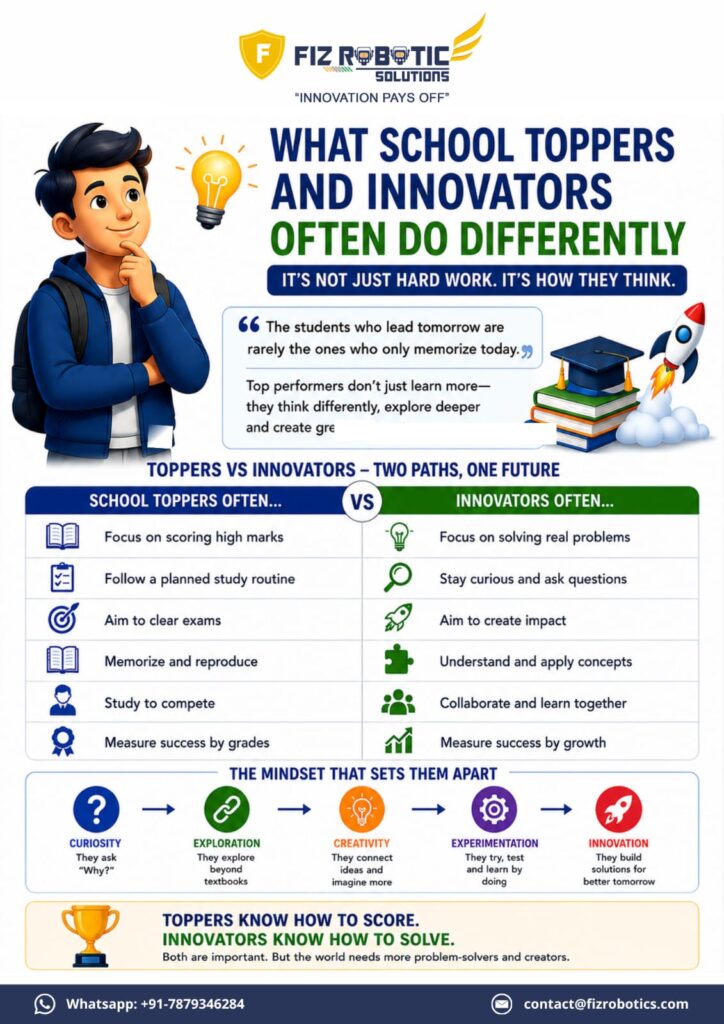
“The students who lead tomorrow are rarely the ones who only memorize today.”
Every school has academic achievers. Every school has talented students. But when we closely observe the journey of exceptional performers—those who not only top examinations but also become innovators, entrepreneurs, researchers, engineers, and problem-solvers—we discover a fascinating pattern.
Their success is rarely built on textbooks alone.
Across the world, schools are witnessing a significant shift in education. The focus is gradually moving from “What students know” to “What students can create.” This transition is redefining the skills that matter most in the 21st century.
The question for school leaders is no longer whether students can score well in examinations. The real question is:
Are students learning how to think, build, experiment, and innovate?
The Hidden Habit of High Performers
Many school toppers share a common characteristic. They do not simply consume information—they apply it.
Instead of only learning scientific theories, they test them.
Instead of memorizing formulas, they use them to solve real-world challenges.
Instead of asking, “Will this come in the exam?” they ask, “Can I build something with this?”
This practical mindset develops confidence, analytical thinking, and creativity—qualities that traditional learning environments often struggle to cultivate.
Interestingly, many of today’s innovators were introduced to hands-on learning at an early age through STEM activities, Robotics projects, Electronics experiments, AI applications, and Aeromodelling challenges.
These experiences transformed classrooms into innovation hubs.
Innovation Begins Where Curiosity Meets Opportunity
Students are naturally curious.
They want to know how drones fly.
They wonder how artificial intelligence makes decisions.
They are fascinated by automated machines and smart devices.
The challenge is that curiosity often fades when students have limited opportunities to explore beyond textbooks.
Schools that consistently produce future-ready learners create environments where questions are encouraged and experimentation is celebrated.
This is where STEM education plays a transformative role.
Rather than teaching isolated subjects, STEM integrates Science, Technology, Engineering, and Mathematics into practical learning experiences.
The result?
Students begin to see concepts in action rather than merely reading about them.
The New Benchmark for Progressive Schools
Today, some of the most forward-thinking institutions are no longer measuring success solely through examination results.
They are focusing on:
- Problem-solving abilities
- Design thinking
- Innovation culture
- Team collaboration
- Technological literacy
- Entrepreneurial mindset
These schools understand an important reality:
The careers of tomorrow will belong to creators, not just consumers.
As industries continue embracing Robotics, Electronics, AI, and advanced technologies, students need exposure to these domains long before they enter universities.
The schools that recognize this early often become the schools that parents actively seek.
A Question Every School Management Team Should Ask
Imagine two students graduating from the same grade.
One has mastered theory.
The other has mastered theory while also building robots, programming intelligent systems, designing engineering models, and participating in innovation challenges.
Which student is likely to adapt faster in a rapidly changing world?
The answer is obvious.
This is why many educational institutions are exploring the concept of establishing dedicated innovation spaces and considering a Robotics Lab setup at your campus.
Not because robotics is a trend.
But because innovation has become a necessity.
Building a Culture, Not Just a Laboratory
The most successful innovation programs are not defined by equipment alone.
They are defined by culture.
A culture where students are encouraged to fail, learn, improve, and create.
A culture where learning extends beyond the classroom walls.
A culture where technology becomes a tool for imagination.
Schools seeking such transformation should also evaluate implementation models carefully. Transparency, long-term support, curriculum integration, and clarity in pricing matter significantly. Many institutions today specifically look for partners offering no hidden charges while setting up Robotics Lab infrastructure, ensuring sustainability and trust throughout the journey.
The Future Belongs to Builders
The next generation of leaders will not emerge solely from examination halls.
They will emerge from spaces where ideas become prototypes.
Where curiosity becomes invention.
Where students learn not only how things work—but how to make things work better.
At FIZ Robotic Solutions, we have observed one consistent truth across thousands of young learners:
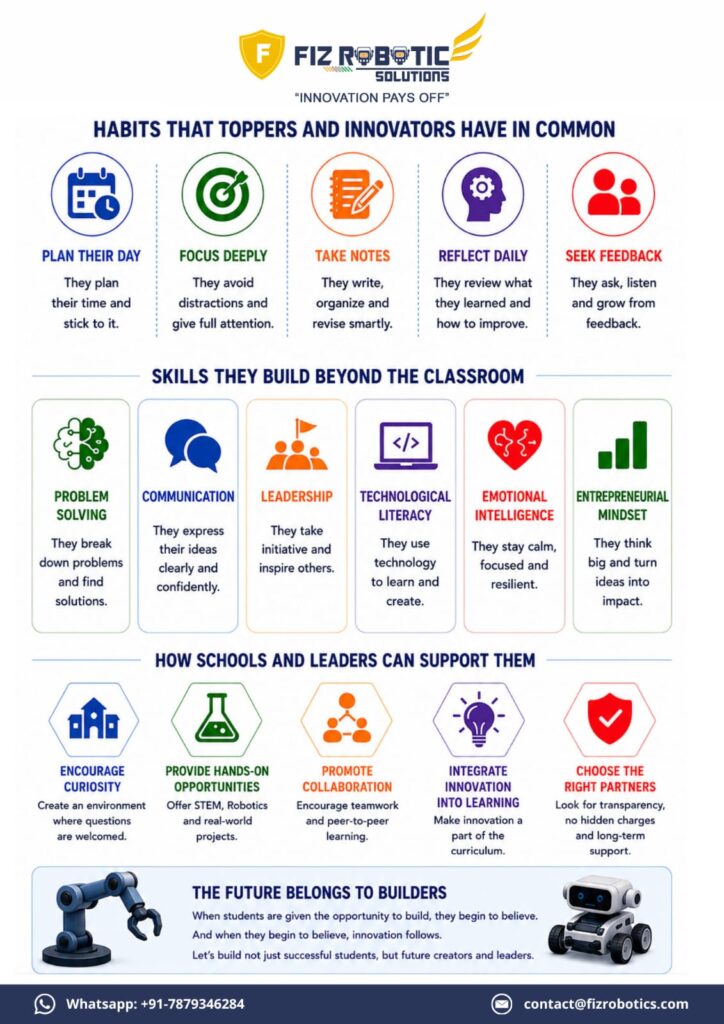
When students are given the opportunity to build, they begin to believe.
And when they begin to believe, innovation follows.
That is the difference between studying the future and creating it.