
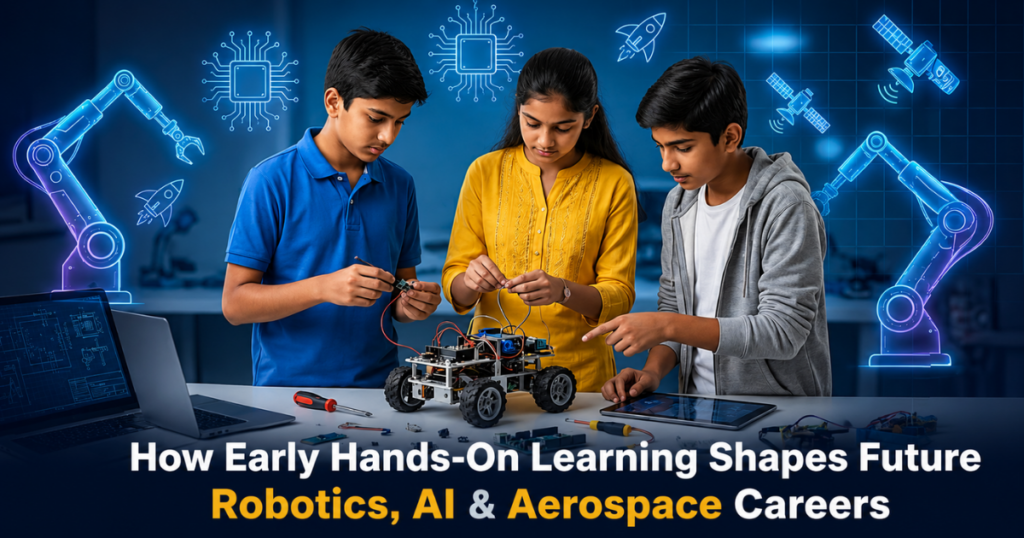
The careers that will define the next decade—robotics, artificial intelligence, and aerospace—are no longer distant ambitions. They are becoming mainstream industries, creating opportunities faster than traditional education systems can adapt.
What most people don’t realize is this:
The foundation for these careers is built far earlier than college or even senior school.
It begins with hands-on learning.
Curiosity Comes Before Careers
Every robotics engineer, AI researcher, or aerospace innovator starts the same way—with curiosity.
- Why does this move?
- What happens if I change this wire?
- How does this system think or fly?
Early exposure to hands-on learning transforms curiosity into confidence. When students physically build, test, and modify things, they stop fearing technology and start understanding it.
This shift in mindset is what shapes future career paths.
Why Early Hands-On Learning Matters
Hands-on learning engages the brain differently than theoretical study. It develops:
- Logical and computational thinking
- Problem-solving under uncertainty
- Spatial and mechanical understanding
- Patience, resilience, and creativity
In fields like robotics, AI, and aerospace—where systems are complex and interconnected—these skills are not optional. They are essential.
Students who start early don’t just learn faster later; they think differently.
Robotics: Learning Systems, Not Just Robots
Robotics is not about assembling machines—it’s about understanding systems.
Early hands-on exposure teaches students:
- How sensors interact with environments
- How electronics, mechanics, and logic work together
- How failures reveal design flaws
A student who has built robots from basic components gains an intuitive understanding that cannot be replaced by simulations or ready-made kits.
By the time they reach advanced studies, robotics feels familiar—not intimidating.
AI: Thinking Before Coding
Contrary to popular belief, AI learning doesn’t begin with complex code. It begins with:
- Logical reasoning
- Pattern recognition
- Decision-making processes
Hands-on projects train students to think in terms of inputs, processing, and outputs—the core structure of AI systems.
When students learn this early, AI becomes a natural extension of their thinking rather than an abstract subject introduced too late.
Aerospace: Confidence to Work with Complexity
Aerospace demands precision, discipline, and deep conceptual clarity. Early exposure to aeromodelling and flight principles helps students:
- Understand forces, motion, and control systems
- Develop respect for safety and accuracy
- Build confidence working with complex mechanisms
Students who have experimented with flying models and control systems early often gravitate naturally toward aerospace careers later.
The Problem with Late Exposure
Many students are introduced to these fields only in higher education—often through theory-heavy curricula. By then:
- Fear of complexity sets in
- Learning feels overwhelming
- Confidence gaps appear
Early hands-on learning removes this barrier. It normalizes experimentation and failure as part of growth.
How FIZ Robotic Solutions (FRS) Builds Future-Ready Learners
At FIZ Robotic Solutions (FRS), hands-on learning is not an add-on—it is the foundation.
FRS programs:
- Start from raw materials and basic components
- Build strong conceptual clarity before advanced tools
- Follow a structured, age-appropriate learning path across classes
- Encourage experimentation, questioning, and innovation
Students don’t just “learn robotics or AI.”
They grow into thinkers and builders who are comfortable with technology.
Final Thought: The Future Is Built Early
Careers in robotics, AI, and aerospace are not shaped in a single course or degree. They are shaped by years of curiosity, confidence, and hands-on experience.
When students learn early—by building, failing, fixing, and building again—they don’t just prepare for future careers.
They create them.
And that is the vision FIZ Robotic Solutions brings to classrooms—helping students start early, think deeply, and build the future with confidence.