
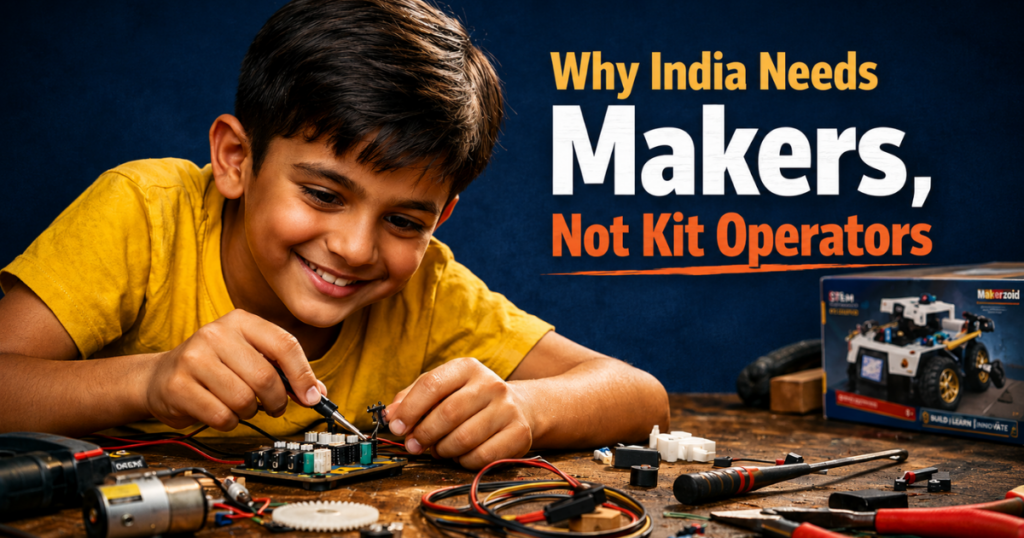
India is at a defining moment in its journey as a global innovation hub. From startups and deep-tech labs to space missions and manufacturing corridors, the country is no longer just consuming technology—it is expected to create it.
Yet, a quiet contradiction exists in our education system.
We are teaching students to operate kits, when the nation desperately needs makers.
The Difference Between a Maker and a Kit Operator
A kit operator follows instructions.
A maker asks questions.
- “What goes where?” vs “Why does this work?”
- “What’s the next step?” vs “What happens if I change this?”
Plug-and-play learning creates comfort. Maker learning creates competence.
In many classrooms today, students assemble robots that already have answers built into them. The wires are labeled. The code is pre-written. The outcome is guaranteed.
But innovation has never come from guaranteed outcomes.
India’s Future Cannot Run on Instructions Alone
India’s growth story—Make in India, Startup India, Atmanirbhar Bharat—demands something very specific from its future workforce:
- Engineers who can design, not just assemble
- Thinkers who can solve unfamiliar problems
- Innovators who can build from limited resources
Industries in 2026 and beyond will not hand students manuals. They will present unstructured problems.
And students trained only as kit operators struggle when:
- Something doesn’t work as expected
- Components behave differently in real life
- There is no step-by-step guide to follow
Why Maker Learning Is a National Need
True makers are comfortable with:
- Raw materials
- Basic electronics and mechanics
- Failure, debugging, and redesign
They understand systems from the ground up. This mindset is what fuels:
- Robotics innovation
- Hardware startups
- Core engineering research
- Indigenous technology development
India doesn’t need more people who can run machines.
India needs people who can build them.
The Problem Starts Early—in Schools
The shift from maker to operator begins in school classrooms.
When learning is reduced to:
- Pre-designed kits
- Fixed outcomes
- Time-bound “successful” demos
Students lose:
- Curiosity
- Patience
- Confidence to experiment
Over time, they start believing that technology is something to be used, not understood.
This belief is dangerous in a country aiming to lead in AI, robotics, and advanced manufacturing.
How FIZ Robotic Solutions Is Creating Makers
At FIZ Robotic Solutions (FRS), the philosophy is clear:
Don’t give answers first. Build understanding first.
FRS programs focus on:
- Teaching from raw components instead of ready-made kits
- Strong foundations in electronics, robotics, AI, and aeromodelling
- Age-appropriate progression across all classes
- Hands-on problem solving, not scripted assembly
Students are encouraged to:
- Experiment
- Make mistakes
- Ask “why” repeatedly
- Build confidence through creation
The goal is not to finish a kit.
The goal is to develop a maker mindset.
The Long-Term Impact: Makers Build Nations
Makers grow into:
- Engineers who innovate
- Entrepreneurs who create jobs
- Researchers who push boundaries
- Leaders who understand technology deeply
When students learn from scratch, they don’t fear complexity—they respect it.
And that respect is what turns curiosity into capability.
Final Thought
India’s future will not be written by students who followed instructions perfectly.
It will be written by those who:
- Took things apart
- Asked uncomfortable questions
- Failed multiple times
- Built something better each time
India doesn’t need more kit operators.
India needs makers.
And the journey to create them must begin in our classrooms—with the right learning philosophy, the right mentorship, and the right partners like FIZ Robotic Solutions.