
A perfectly silent classroom has long been considered a symbol of discipline.
Straight rows.
Minimal movement.
Uniform answers.
Controlled interaction.
For decades, education systems across the world associated order with effectiveness.
But as schools prepare students for a future driven by innovation, entrepreneurship, technology, and problem-solving, an important question is beginning to emerge:
Can creativity truly grow in environments built entirely around control?
The answer is more nuanced than it appears.
Because discipline and creative freedom are often misunderstood as opposites.
In reality, the future of education may depend on how successfully schools balance both.
- Discipline Builds Structure. Creative Freedom Builds Possibility.
Discipline gives students:
- consistency,
- focus,
- accountability,
- and the ability to execute.
Without discipline, ideas rarely move beyond imagination.
But creative freedom serves a completely different purpose.
One creates stability.
The other creates innovation.
And modern education cannot afford to ignore either.
- The Problem Begins When Discipline Becomes Restriction
There is a subtle difference between:
* guiding students,
and:
* controlling every step of their thinking.
But innovation rarely emerges from fear of being wrong.
Students who are constantly trained to search for “the correct answer” may gradually stop exploring their own ideas altogether.
Not because they lack creativity.
But because the environment unintentionally rewards certainty more than curiosity.
- Creative Freedom Does Not Mean Chaos
One of the biggest misconceptions in education is that creativity requires complete absence of structure.
It does not.
The difference is this:
Students are given enough freedom to think independently within a structured ecosystem.
That balance matters.
Because unlimited freedom without direction creates confusion.
But excessive control without exploration limits imagination.
Future-ready education may depend on finding the middle ground.
- Real Innovation Often Looks Uncomfortable
Creative learning environments rarely appear perfectly predictable.
From the outside, this process may appear messy.
But that “mess” is often where genuine thinking begins.
Innovation is not usually born from repetition.
It emerges from experimentation.
And experimentation naturally includes uncertainty.
- Why Future Industries Will Value Both Skills
The workplaces students enter in the coming decade will not reward only technical knowledge.
This means future professionals will need both:
the discipline to build,
and:
the creative freedom to imagine.
Education systems that develop only one side may leave students incomplete.
- The Most Effective Learning Spaces Already Blend Both
Some of the strongest learning environments today no longer separate discipline and creativity.
Instead, they integrate them naturally.
For example:
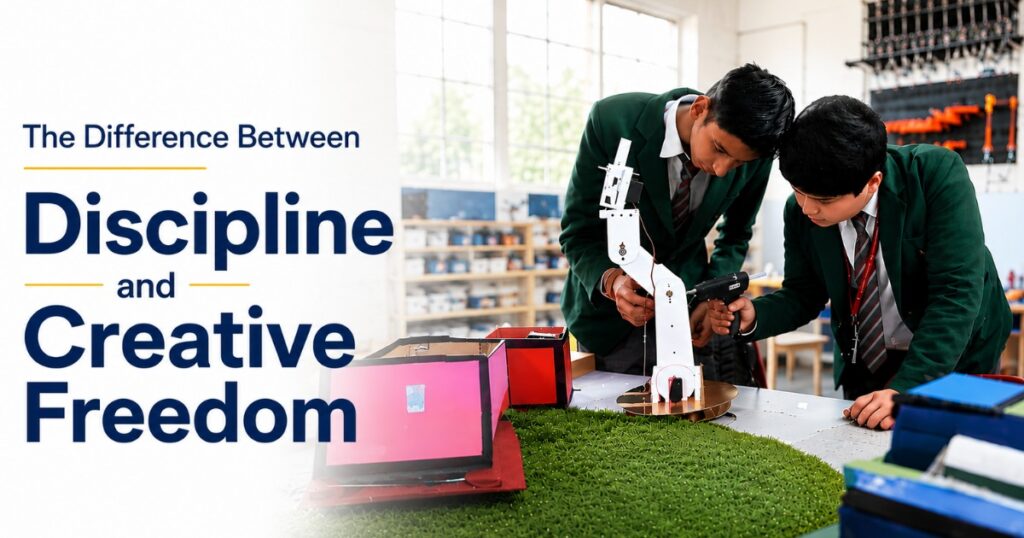
A student working on a robotics prototype may require:
- discipline to complete the project,
- patience to troubleshoot errors,
- structure to follow timelines,
- and creative thinking to improve the design.
This combination creates a much deeper learning experience than passive instruction alone.
Organizations like FIZ Robotic Solutions are helping schools create such innovation-driven ecosystems where students are encouraged not only to learn concepts, but to apply them through exploration, experimentation, and practical problem-solving.
Because future-ready learning is not about removing discipline from classrooms.
It is about redefining how discipline supports creativity rather than suppressing it.
The goal may no longer be creating students who only follow systems efficiently.
It may be creating students capable of improving those systems.
And that requires more than obedience.
It requires imagination.
Perhaps the real purpose of education is not choosing between discipline and creative freedom.
Perhaps it is teaching students how to use both together.
Because discipline helps students turn ideas into reality.
But creative freedom is what gives them ideas worth building in the first place.