
Walk into any classroom during a free period.
You will notice something interesting.
A group of students sitting silently while finishing homework may look “disciplined.”
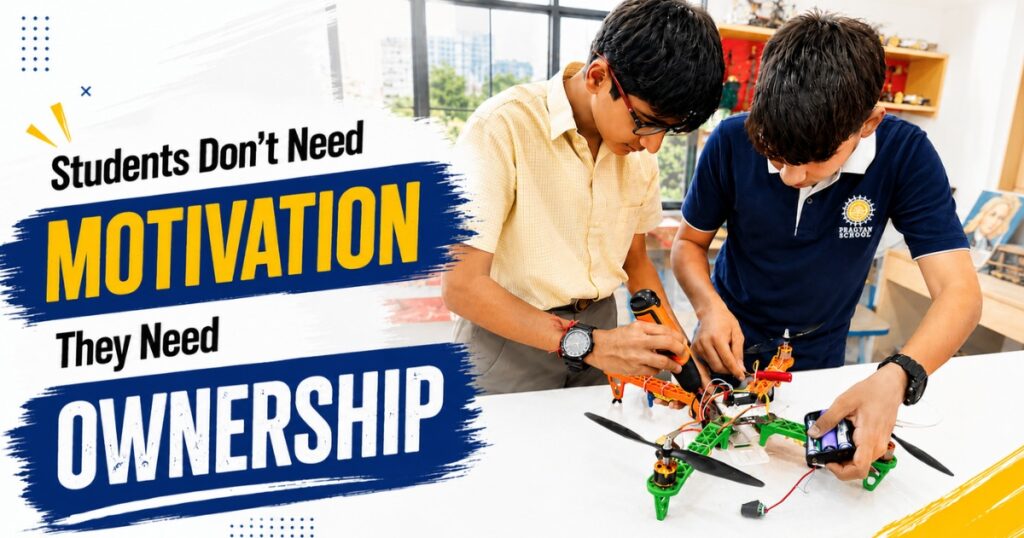
But somewhere else in the same school, four students arguing over why their robot stopped moving, one student holding wires in confusion, another searching for a solution, and someone saying,
“Wait… I think I figured it out.”
That room is louder.
Messier.
Less controlled.
And strangely… far more alive.
Because one group is trying to complete work.
The other group is trying to make something work.
There is a difference.
A very important one.
Most students are not lazy.
They are disconnected.
There is a silent gap between:
“What students are asked to do”
and
“What students actually feel connected to.”
And that gap is where attention disappears.
Not because students hate learning.
But because very few students enjoy feeling like passengers in their own education.
Think about the things students voluntarily spend hours on.
- Gaming.
- Editing videos.
- Building social media pages.
- Sports.
- Music.
- Designing.
- Creating content.
- Modifying bikes.
- Exploring apps.
Nobody stands next to them saying:
“Please stay motivated.”
Why?
Because ownership creates energy naturally.
People protect what they feel belongs to them.
The same psychology quietly changes inside hands-on learning environments.
The moment students begin creating something themselves, behavior shifts.
Not theoretical learning.
Not memorized answers.
Real interaction.
- A circuit they assembled.
- A prototype they designed.
- A drone they calibrated.
- A robot they failed to fix three times before finally solving the issue.
Suddenly:
- attention increases,
- curiosity becomes visible,
- collaboration feels natural,
- and learning stops feeling forced.
No motivational speech required.
Interestingly, schools sometimes misunderstand what engagement actually looks like.
Real engagement is not always silent.
That is not a distraction.
That is involvement.
And involvement changes learning far more deeply than temporary inspiration.
The modern education system has spent years trying to answer questions like:
“How do we motivate students?”
Maybe the better question is:
“How do we make students feel responsible for their learning?”
Because motivated students may work temporarily.
But students with ownership behave differently.
They:
- explore beyond instructions,
- solve problems independently,
- continue after failure,
- and often surprise even themselves.
Ownership quietly builds initiative.
And initiative cannot be memorized from textbooks.
This is one of the biggest reasons future-focused schools are rethinking learning spaces entirely.
Not every meaningful lesson happens through lectures.
That environment matters.
It changes how students see themselves.
Organizations like FIZ Robotic Solutions are helping schools create these kinds of ecosystems — spaces where students do not simply “study technology,” but actively interact, build, experiment, and innovate through it.
Because innovation is rarely born in environments where students only receive instructions.
It grows where students are trusted to create.
And perhaps that is the real shift in education needs.
Less pressure to constantly “motivate” students.
Because once students begin saying:
“This is our project.”
“We built this.”
“Let us try again.”
something changes internally.
Learning becomes personal.
And personal learning stays longer than forced learning ever will.