
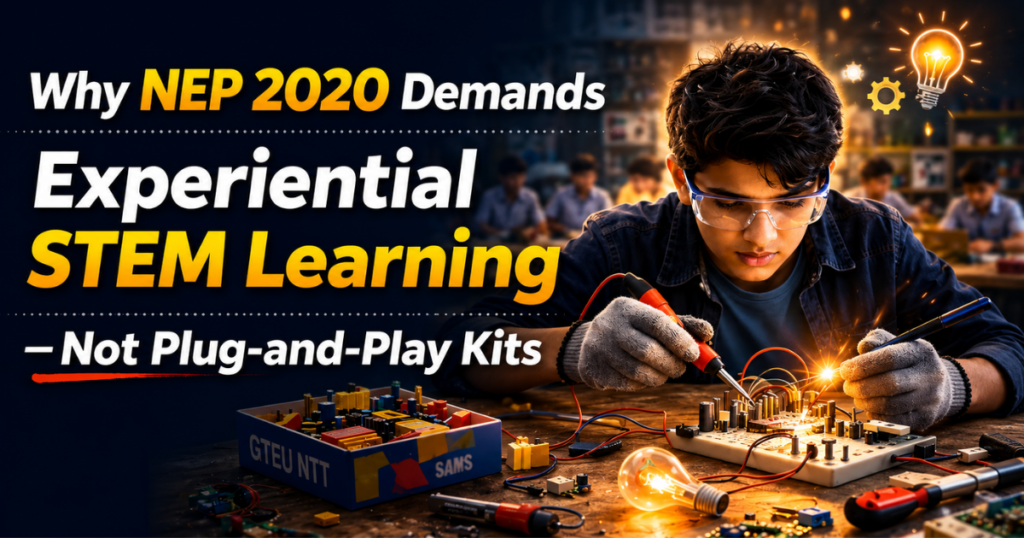
The National Education Policy (NEP) 2020 was introduced with a clear purpose—to move Indian education away from rote learning and towards meaningful understanding. It encourages students to ask questions, explore ideas, and apply concepts in real-life situations. Nowhere is this shift more important than in STEM education.
However, many schools trying to adopt STEM learning unknowingly miss the core message of NEP 2020 by relying heavily on plug-and-play kits. While these kits look modern and attractive, they do not always support the deeper learning the policy truly demands.
NEP 2020 strongly promotes experiential learning. This means students should not just follow instructions but should understand why something works, what happens when it doesn’t, and how it can be improved. Learning should be active, not passive. Students should engage with concepts, not just complete activities.
Plug-and-play kits, on the other hand, usually come with fixed steps and predictable outcomes. Students assemble parts exactly as instructed, and the model works as expected. While this may create excitement initially, it leaves very little room for thinking, questioning, or problem-solving. When everything is predefined, students are not encouraged to explore alternatives or learn from mistakes.
True STEM learning happens when students face challenges. When a circuit fails, when a robot does not move as expected, or when code produces an error, students begin to think critically. They learn to observe, analyze, test, and correct. This process of trial and error builds logical thinking, patience, and confidence—skills that textbooks alone cannot teach.
This is why experiential STEM learning is at the heart of NEP 2020. It prepares students for real-world situations where problems are not neatly defined and solutions are not given in advance. It helps them become independent thinkers rather than instruction followers.
Robotics labs play a crucial role in enabling this kind of learning—but only when they are designed with the right approach. A robotics lab should not be a room filled with ready-made kits. It should be a space where students experiment freely, understand components deeply, and learn by doing. The focus should be on concepts first, and tools second.
At FIZ Robotic Solutions (FRS), we design robotics and STEM programs that truly align with the vision of NEP 2020. Our approach emphasizes understanding over assembly and thinking over imitation. Students are encouraged to explore concepts before using components, so they know not just how something works, but why it works.
We work closely with schools to create experiential robotics labs that fit their academic goals and grade levels. Along with hands-on learning, we also support teachers through training and structured curriculum integration, ensuring that experiential learning becomes a part of everyday classroom culture—not just an occasional activity.
For students, this approach builds strong foundations in problem-solving and logical reasoning. For parents, it ensures that learning goes beyond marks and prepares children for future careers. For schools, it creates a learning environment that truly reflects the intent of NEP 2020 and sets them apart as forward-thinking institutions.
NEP 2020 is not asking schools to simply adopt new tools. It is asking them to transform the way students learn. Experiential STEM learning is not a trend—it is a necessity for the future.
With FIZ Robotic Solutions (FRS), schools can move beyond plug-and-play learning and create meaningful, future-ready STEM experiences that help students think, innovate, and lead.