
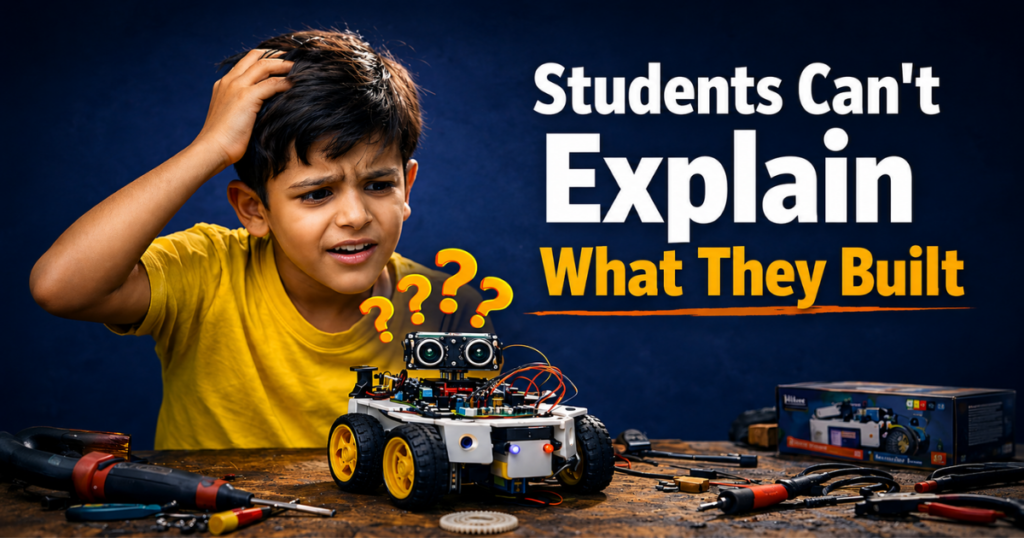
Walk into many school robotics labs today and you’ll see impressive-looking models—robots that move, lights that blink, and sensors that respond. But ask a simple question: “Can you explain how this works?”
Too often, students go silent.
This is one of the biggest challenges in today’s STEM education. Students are building things, but they don’t truly understand them.
The problem is not with the students. The problem lies in how robotics and STEM are being taught.
In many schools, learning has become about completing activities rather than understanding concepts. Students follow instructions, assemble parts, upload pre-written code, and watch the final output. The model works—but the learning stops there.
When students cannot explain what they built, it means learning has remained superficial.
True education is not about making something work once. It is about being able to explain why it works, how each component contributes, and what would happen if something changed.
This gap becomes especially visible during competitions, assessments, or even parent interactions. Students proudly present their projects, but struggle to answer basic questions about circuits, sensors, logic, or code. This creates a false sense of achievement—good results without deep understanding.
One major reason for this is the overuse of ready-made and plug-and-play kits. These kits are designed to deliver quick outcomes. While they look engaging, they often hide the real learning behind fixed steps and predefined results. Students become assemblers, not thinkers.
When everything is already decided, students don’t get the chance to ask questions, make mistakes, or explore alternatives. There is no debugging, no reasoning, and no ownership of learning.
Real understanding comes when students struggle a little.
When a robot doesn’t move, when a circuit fails, or when code produces an error, students are forced to think. They observe, test, correct, and try again. This is where learning becomes meaningful. This is where students gain confidence and clarity.
This is exactly what experiential STEM learning aims to achieve—and what NEP 2020 strongly advocates.
At FIZ Robotic Solutions (FRS), we believe that if a student builds something, they must be able to explain it. That belief shapes every robotics lab and STEM program we design.
Our approach is simple: concepts come first.
Before students touch components, they understand what each part does. Before assembling a robot, they learn how logic, sensors, motors, and power systems work. When they finally build, they know what they are doing—and more importantly, why they are doing it.
We encourage students to explain their projects in their own words. They are asked to describe problems, solutions, and improvements. This builds communication skills along with technical understanding.
FRS robotics labs are designed to support exploration, not shortcuts. Students are allowed to experiment, fail, debug, and rebuild. Teachers are trained to guide thinking, not just instructions. Learning becomes a process, not a performance.
For students, this leads to deeper confidence and stronger problem-solving skills. For parents, it means their children are truly learning—not just showcasing models. For schools, it creates a culture of understanding, innovation, and academic credibility.
In the long run, the goal of STEM education is not to produce robots—it is to produce thinkers.
If students can’t explain what they built, education has missed its purpose.
With FIZ Robotic Solutions (FRS), schools can move beyond surface-level learning and build robotics programs where students don’t just create projects—they understand them.
Because real learning begins when students can explain their own work.