
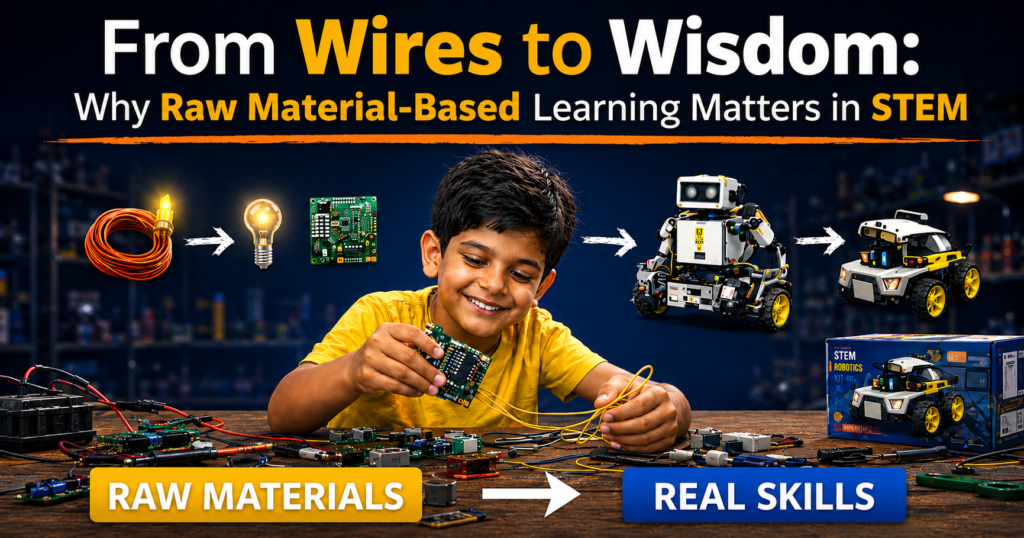
Walk into a typical STEM lab, and you’ll often see neatly packed kits—pre-designed components, fixed instructions, and expected outcomes. Students open the box, follow steps, and build something that works.
It looks impressive.
But here’s the real question:
Are students learning deeply—or just assembling efficiently?
In today’s world of robotics, innovation, and technology, the difference between the two matters more than ever.
The Problem with Ready-Made Learning
STEM kits have made it easier to introduce hands-on learning in schools. But over time, they’ve also created a hidden limitation.
When everything is pre-arranged, students don’t need to think much. The process becomes predictable:
- Pick the right part
- Connect it as shown
- Get the expected output
The result? A working model—but limited understanding.
Students know what to do, but not always why they are doing it.
And that’s where learning starts losing its depth.
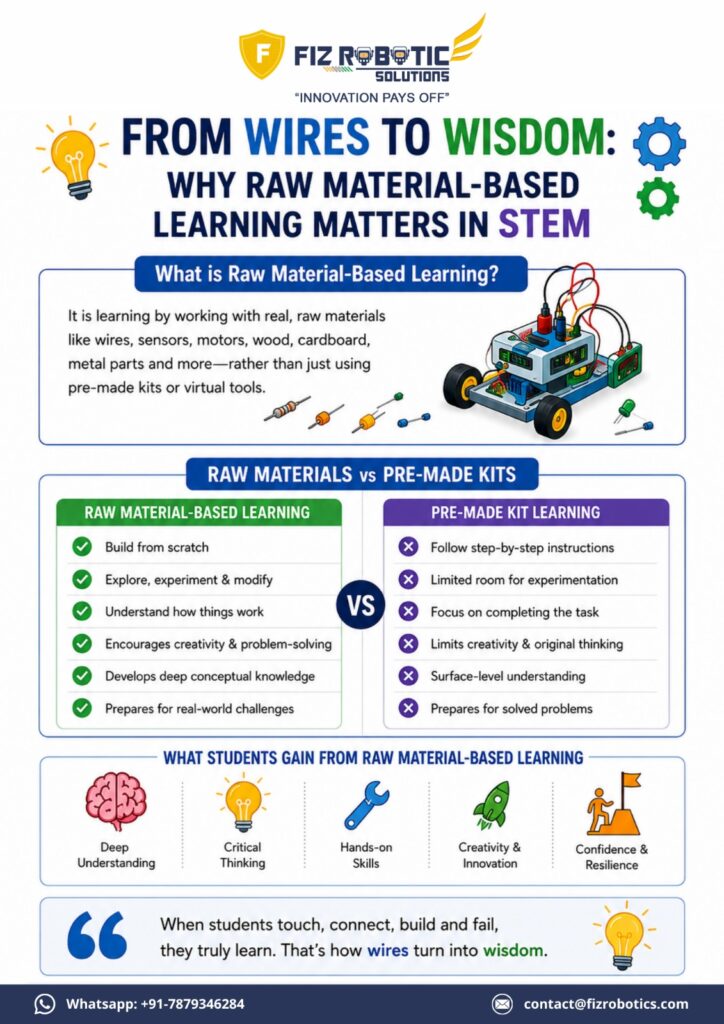
Why Raw Material-Based Learning Changes Everything
Now imagine a different approach.
Instead of giving students a ready-made kit, give them basic components—wires, sensors, motors, boards—and a challenge.
Suddenly, the process is no longer about following instructions. It becomes about figuring things out.
Students start asking:
- Which component should I use?
- How do I connect this?
- Why isn’t this working?
This is where real learning begins.
Working with raw materials pushes students to think, experiment, and solve problems on their own. It turns passive learners into active creators.
From Doing to Understanding
For parents, this approach answers an important concern:
Is my child truly developing skills, or just completing tasks?
For school owners, it reflects the quality of education being delivered:
Are we encouraging creativity, or just ensuring completion?
Because in the new era of robotics, the goal is not just to build projects—it’s to build understanding.
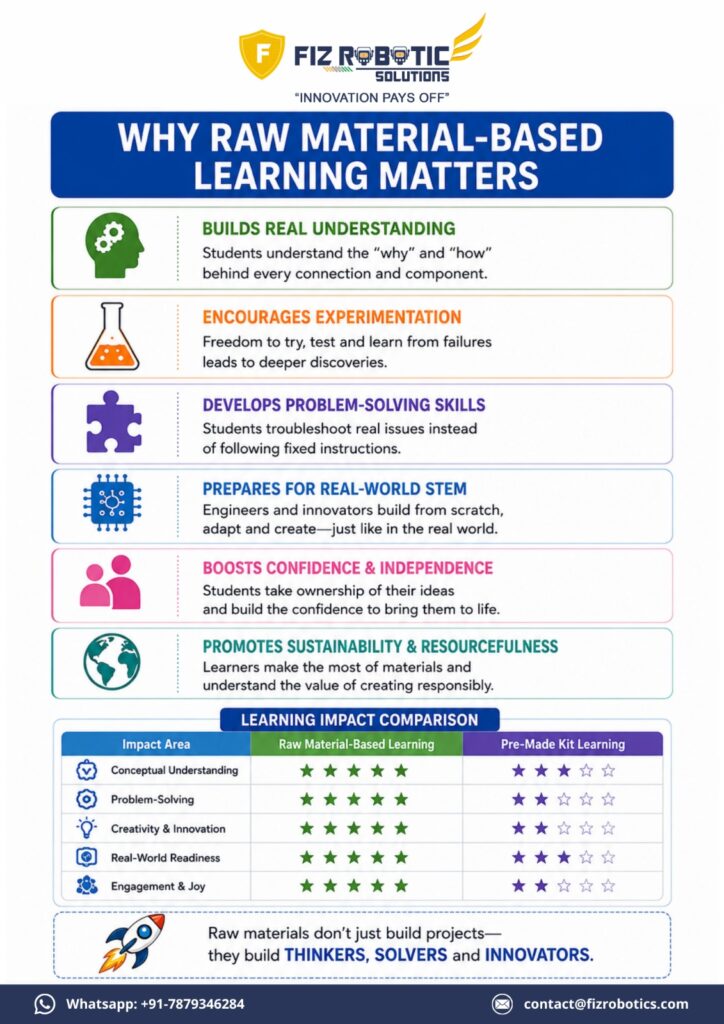
Raw material-based learning helps students:
- Develop strong conceptual clarity
- Improve logical thinking
- Learn through trial and error
- Build confidence in their abilities
Most importantly, it teaches them that failure is not the end—it’s part of the process.
The Role of Struggle in Real Learning
One of the biggest advantages of this approach is something many classrooms try to avoid—struggle.
When students don’t get instant results, they are forced to think deeper. They troubleshoot, test different solutions, and slowly arrive at the answer.
This process builds resilience and problem-solving skills—qualities that no ready-made kit can offer.
In contrast, when everything works on the first attempt, learning often stays on the surface.
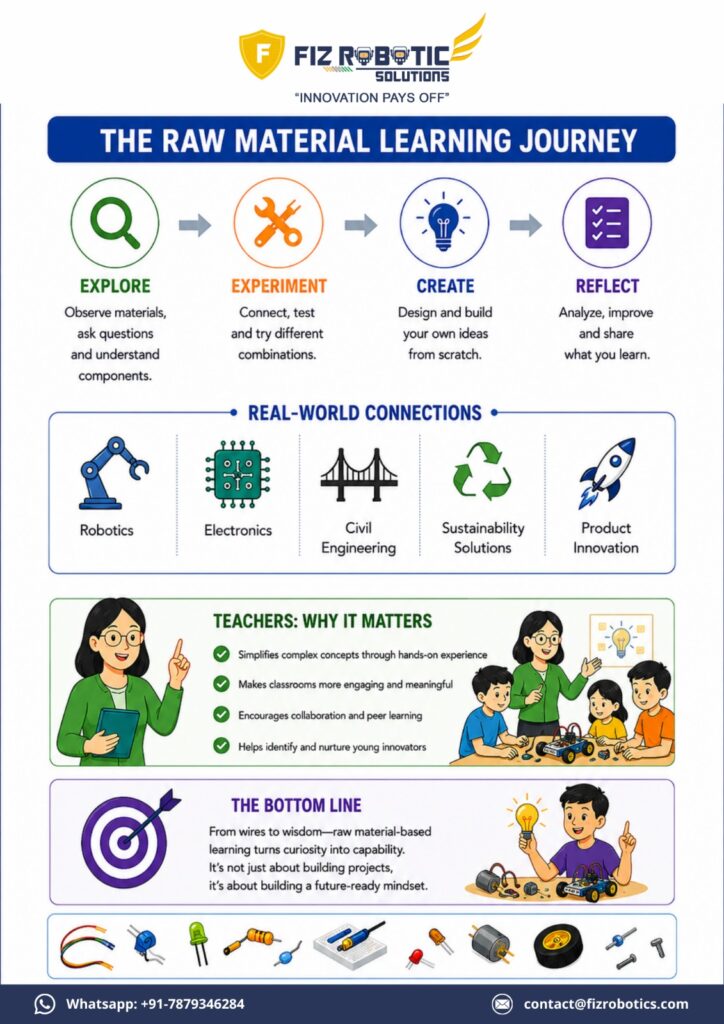
Preparing Students for the Real World
The real world doesn’t provide step-by-step instructions.
Whether it’s technology, engineering, or any field driven by innovation, challenges are open-ended. Solutions need to be discovered, not followed.
By working with raw materials, students get a taste of this reality early on.
They learn to:
- Approach problems independently
- Think creatively under constraints
- Build solutions from scratch
These are the skills that truly prepare them for the future.
Making the Shift in Schools
Introducing raw material-based learning doesn’t mean removing structure—it means redefining it.
Schools need to:
- Focus on concepts before components
- Encourage experimentation over perfection
- Allow students the freedom to explore
- Provide guidance without over-directing
It’s about creating an environment where learning is not limited to instructions, but driven by curiosity.
Where the Right Approach Matters
This shift requires more than just changing materials—it requires the right mindset and guidance.
FRS follows this philosophy by moving beyond kit-based learning and focusing on concept-driven, raw material-based STEM education.
Instead of simply guiding students to complete projects, FRS encourages them to understand the fundamentals, experiment with ideas, and build solutions from the ground up.
This approach ensures that students don’t just use technology—they learn how to create it.
From Wires to Wisdom
At its core, STEM education is not about wires, circuits, or machines.
It’s about how these elements come together to build understanding.