
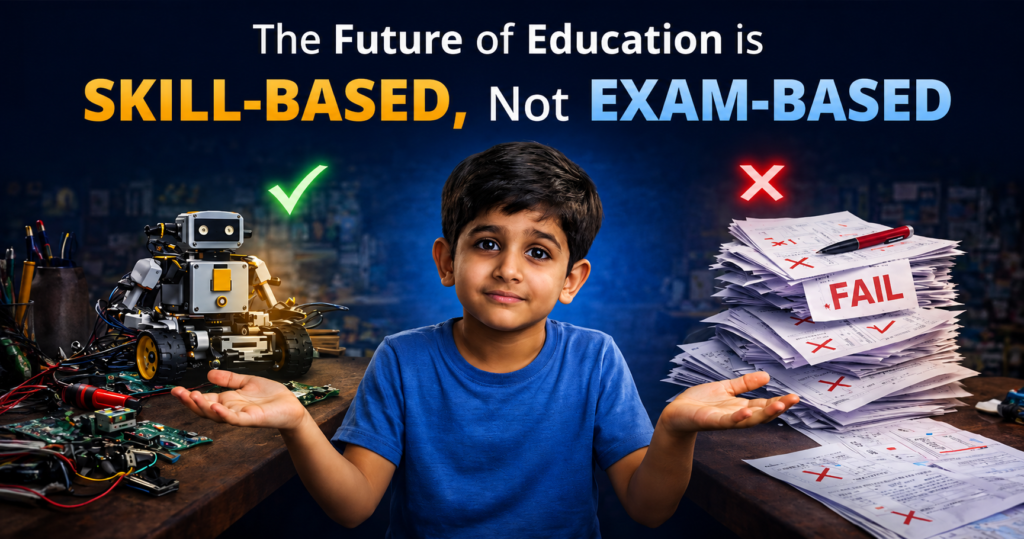
For decades, education has followed a familiar pattern—learn, memorize, and perform in exams. Marks became the measure of success, and report cards defined a student’s potential.
But today, that definition is rapidly changing.
Because the world students are stepping into no longer asks, “What did you score?”
It asks, “What can you do?”
Welcome to the new reality—where skills matter more than scores.
Why the Old Model Is Losing Relevance
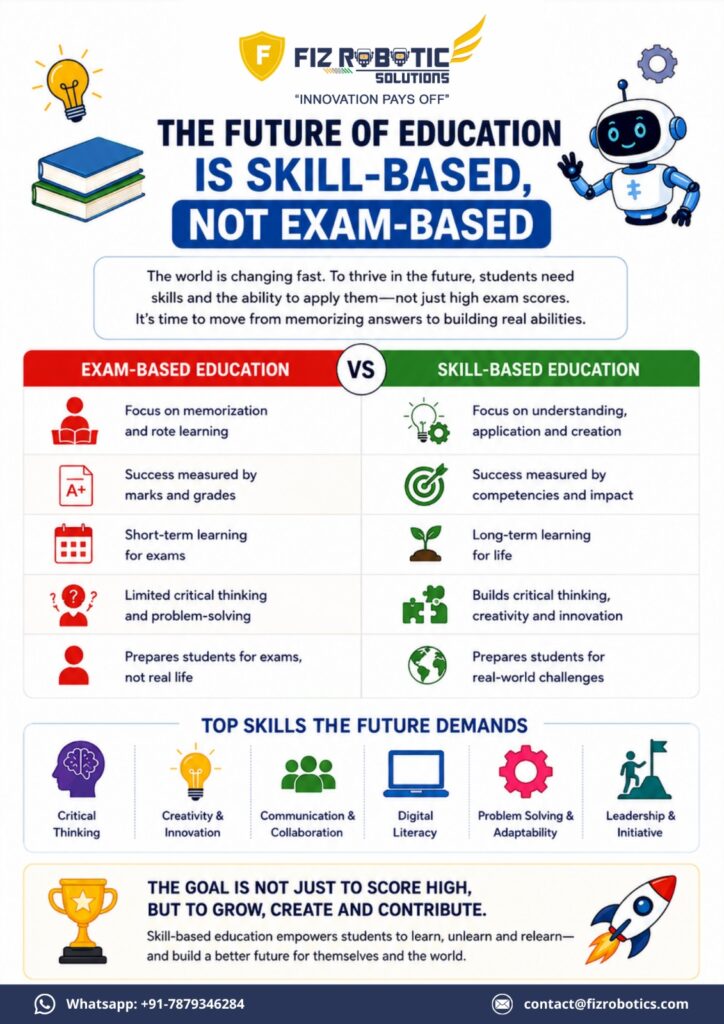
Exams were designed to test knowledge. But in today’s fast-changing world of technology, robotics, and innovation, knowledge alone is not enough.
Information is everywhere. A student can access answers within seconds. What truly sets them apart is their ability to:
- Think critically
- Solve real problems
- Apply what they’ve learned
- Adapt to new challenges
Unfortunately, exam-focused learning often limits these abilities.
Students become excellent at remembering—but not always at understanding. They prepare for tests, not for real-life situations.
And that’s where the gap begins.
What Parents and Schools Are Starting to Realize
Parents today are asking a deeper question:
Is my child prepared for the future, or just for exams?
School owners are also rethinking their approach:
Are we building rank holders, or capable individuals?
Because success today is no longer defined by marksheets—it’s defined by skills, confidence, and adaptability.
In this new era of robotics and technology, industries are looking for individuals who can create, innovate, and improve—not just follow instructions.
What Skill-Based Education Really Means
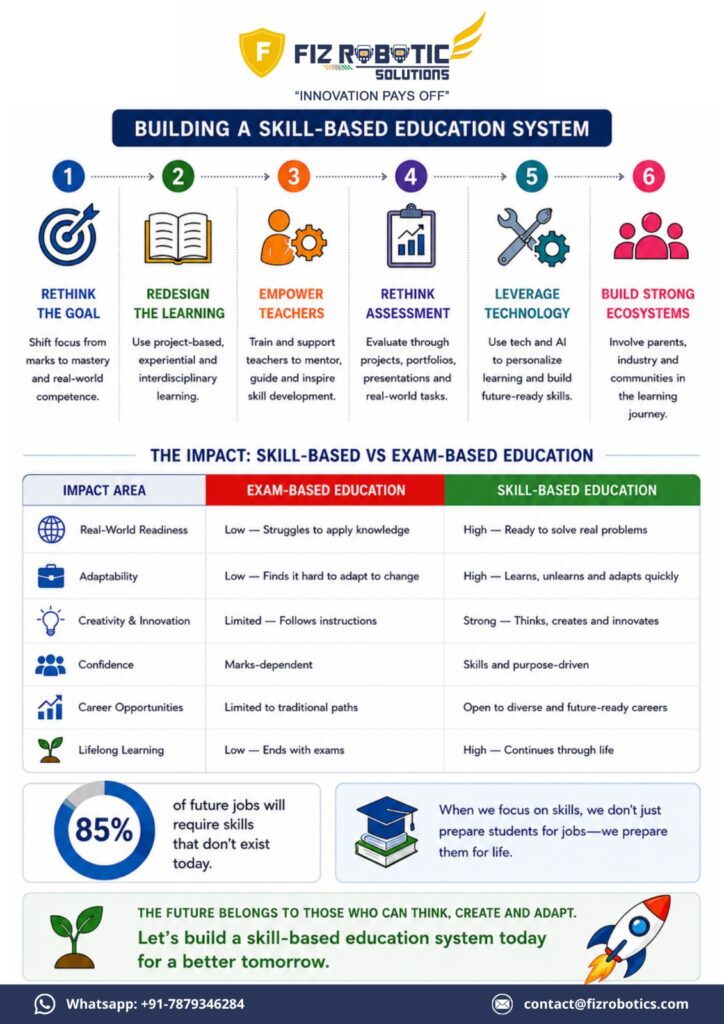
Skill-based education is not about removing exams—it’s about going beyond them.
It focuses on:
- Learning by doing, not just listening
- Understanding concepts instead of memorizing them
- Applying knowledge in practical situations
- Encouraging creativity and independent thinking
For students, this makes learning more engaging and meaningful.
Instead of asking, “Will this come in the exam?”, they begin to ask, “How does this actually work?”
That shift changes everything.
The Role of Robotics and Technology in Skill Development
Subjects like robotics naturally support skill-based learning.
When students build and program something, they are not just completing a task—they are:
- Solving problems
- Testing ideas
- Learning from mistakes
- Thinking logically
This process builds real-world skills that no exam alone can measure.
It also nurtures innovation, which is essential in today’s competitive and technology-driven environment.
The Challenge Schools Face
Many schools understand the importance of skill-based education. But implementing it effectively is not always easy.
Sometimes, it gets reduced to occasional activities or workshops. Other times, it remains limited to well-equipped labs without a structured learning approach.
The result? Students participate—but don’t always progress.
To truly shift from exam-based to skill-based education, schools need a consistent, concept-driven system—not just isolated efforts.
The Right Way Forward
The future of education lies in balance.
Exams will continue to exist—but they should not be the only goal. They should be one part of a larger learning journey that focuses on building real skills.
Schools need to create environments where:
- Students are encouraged to explore and experiment
- Learning is connected to real-world applications
- Skills are developed alongside academic knowledge
And most importantly, where students feel confident in what they can do, not just what they know.
Where the Right Support Makes a Difference
This transformation requires the right guidance and expertise.
FRS works closely with schools to bring this shift into reality. By integrating robotics, technology, and innovation into structured learning programs, FRS ensures that students don’t just study concepts—they apply them.
The focus is not on completing activities, but on building understanding, confidence, and problem-solving abilities.
This approach helps schools move beyond traditional methods and truly prepare students for the future.
Preparing Students for What’s Next
The world ahead will reward those who can think, adapt, and create.
Marks may open doors—but skills will help students walk through them and succeed.