
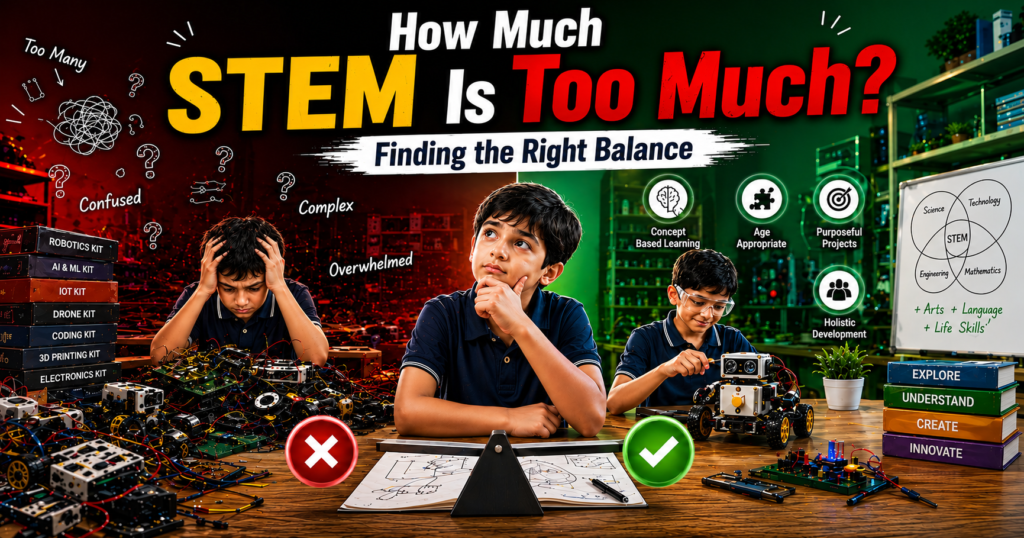
In recent years, STEM education has taken center stage in schools, driven by the growing demand for skills in science, technology, engineering, and mathematics. From robotics labs to coding classes and innovation hubs, institutions are making significant investments to prepare students for the future. However, this rapid expansion raises an important question: how much STEM is too much? While STEM is undeniably valuable, an excessive or poorly balanced approach can lead to cognitive overload, reduced engagement, and missed opportunities for holistic development.
The objective of STEM education is not to maximize quantity, but to optimize quality and relevance. When students are exposed to too many tools, platforms, or complex projects without sufficient conceptual grounding, learning can become overwhelming. Instead of fostering curiosity, it may result in confusion or disengagement. True STEM learning is not about completing multiple projects; it is about understanding the principles behind them and applying that knowledge meaningfully.
A key factor in maintaining balance is age-appropriate learning. For younger students, STEM should focus on exploration, observation, and basic problem-solving through simple, hands-on activities. Overloading them with advanced robotics or coding concepts too early can hinder their natural curiosity. As students progress to higher grades, the complexity of projects and depth of concepts can gradually increase. This structured progression ensures that learning remains engaging and manageable at every stage.
Another important consideration is the integration of STEM with other disciplines. While STEM is crucial, it should not overshadow subjects such as language, arts, and social sciences. Communication skills, creativity, ethical reasoning, and cultural awareness are equally important in shaping well-rounded individuals. For instance, a robotics project can be enriched by incorporating storytelling, design thinking, or real-world social challenges. This interdisciplinary approach not only balances the curriculum but also enhances the overall learning experience.
The role of educators is equally critical in achieving this balance. Teachers must focus on depth over breadth, ensuring that students thoroughly understand key concepts rather than superficially covering multiple topics. Well-structured lesson plans, clear learning objectives, and meaningful assessments can help maintain this focus. Additionally, providing students with time to reflect, experiment, and iterate on their projects is essential for deeper learning.
Time management within the school schedule also plays a significant role. STEM activities should complement academic learning, not compete with it. Allocating dedicated but reasonable time slots for practical sessions ensures that students benefit from hands-on experiences without feeling overburdened. Short, focused activities can often be more effective than lengthy, complex sessions that strain both students and teachers.
At FRS, we strongly believe that the effectiveness of STEM education lies in balance. Our programs are designed to deliver concept-driven, structured learning that aligns with students’ cognitive levels and school curricula. Rather than overwhelming learners with excessive content, we focus on building strong fundamentals through carefully curated projects in robotics, electronics, and emerging technologies.
We work closely with schools and educators to ensure that STEM is seamlessly integrated into the existing framework, without disrupting academic priorities. Our approach emphasizes clarity, engagement, and practical application, enabling students to develop critical thinking and problem-solving skills at a comfortable pace. By providing teacher training, ready-to-use resources, and scalable modules, we ensure that both students and educators experience STEM as an enriching journey, not a burden.
Ultimately, the question is not how much STEM is too much, but how effectively it is delivered. A balanced STEM program nurtures curiosity without causing overwhelm, encourages exploration without compromising depth, and complements other areas of learning. When implemented thoughtfully, STEM becomes a powerful tool for shaping innovative, adaptable, and well-rounded individuals.