
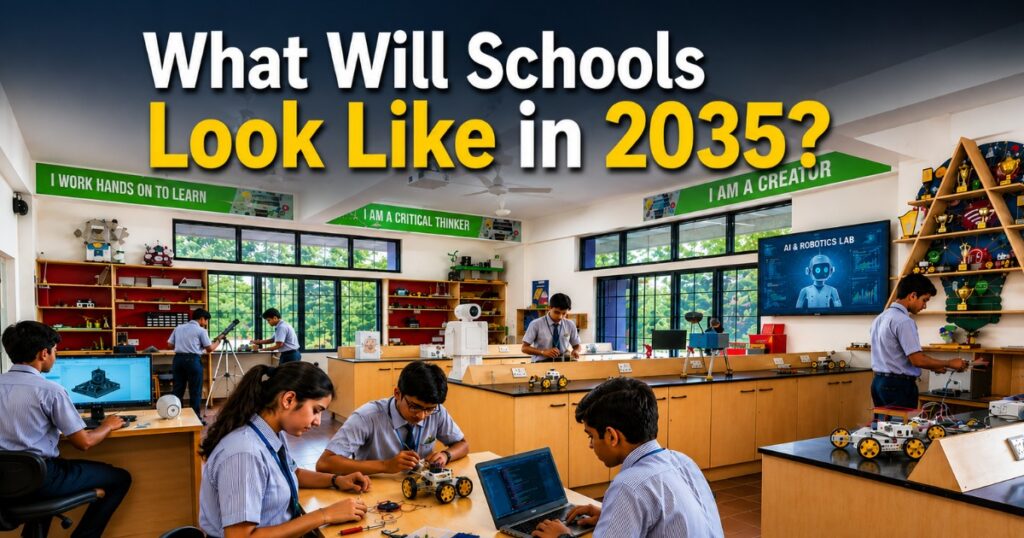
For decades, schools around the world have followed a familiar structure — classrooms, blackboards, textbooks, examinations, and standardized learning. While technology has entered education in many forms, the core system has largely remained the same.
But the next decade may bring the biggest transformation education has ever witnessed.
By 2035, schools may no longer be defined by how well students memorize information, but by how effectively they create, solve, innovate, and adapt.
The question is no longer:
“Will education change?”
The real question is:
“Are schools ready for the kind of future students are walking into?”
1. Classrooms Will Become Creation Spaces
The schools of 2035 will not function as one-way teaching environments where students passively listen for hours.
Instead, classrooms will become:
- innovation spaces,
- collaborative work zones,
- design studios,
- experimentation labs,
- and project-driven learning environments.
Students will spend less time copying notes and more time:
- building models,
- solving practical problems,
- testing ideas,
- and learning through real-world applications.
The focus will shift from:
“Can students remember?”
to:
“Can students create?”
2. Marks Alone Will No Longer Define Capability
Traditional examinations will continue to exist, but they may no longer remain the primary indicator of intelligence.
Future-ready schools will increasingly evaluate:
- problem-solving ability,
- communication skills,
- creativity,
- teamwork,
- leadership,
- adaptability,
- and innovation mindset.
A student who can:
- build a working prototype,
- present an idea confidently,
- collaborate with a team,
- and solve practical challenges,
may stand out more than someone who simply scores high marks.
This shift is already visible across industries today.
Companies are searching for thinkers, creators, and problem-solvers — not only degree holders.
3. Innovation Labs Will Become Essential Infrastructure
In the coming years, innovation labs may become as important as computer labs and libraries.
Schools of 2035 are likely to include:
- Robotics Labs
- AI & Coding Labs
- Electronics & IoT Workspaces
- Drone & Aeromodelling Sections
- 3D Design Studios
- Rapid Prototyping Spaces
Why?
Because future learning cannot remain completely theoretical.
Students understand concepts faster when they:
- build circuits,
- program systems,
- experiment with sensors,
- create automation projects,
- and physically interact with technology.
Hands-on learning creates deeper understanding than memorization ever can.
This is where practical innovation ecosystems created by organizations like FIZ Robotic Solutions are becoming increasingly important for schools that want to prepare students for the future, not just examinations.
4. Teachers Will Evolve Into Mentors & Facilitators
The role of teachers will also transform significantly.
In 2035, teachers may no longer act only as information providers because information itself is becoming instantly accessible through technology and AI tools.
Instead, educators will increasingly guide students in:
- critical thinking,
- project execution,
- experimentation,
- ethical technology use,
- and collaborative learning.
The best teachers of the future may not be the ones who lecture the most —
they may be the ones who inspire curiosity the most.
5. Students Will Learn Across Subjects, Not In Isolation
Real-world problems are never solved using a single subject.
The schools of the future will encourage interdisciplinary learning where students combine:
- science,
- mathematics,
- design,
- coding,
- electronics,
- creativity,
- and entrepreneurship together.
For example:
A robotics project may involve:
* Physics for motion,
* Mathematics for calculations,
* Coding for automation,
* Design for structure,
* and Communication for presentation.
This kind of integrated learning reflects how innovation actually happens in the real world.
6. AI Will Change Education — But Human Skills Will Become More Valuable
Artificial Intelligence will undoubtedly reshape classrooms.
Students may use AI tools for:
* research,
* simulations,
* personalized learning,
* coding assistance,
* and concept visualization.
The future may belong to students who can combine technology with original thinking.
Schools that only teach students how to use technology may fall behind.
Schools that teach students how to create with technology may lead the future.
7. Schools Will Focus More on Innovation Culture
One of the biggest differences in future-ready schools will not be infrastructure alone — it will be culture.
Students innovate best in environments where:
* questions are encouraged,
* experimentation is appreciated,
* failure is accepted as part of learning,
* and curiosity is rewarded.
The most impactful schools of 2035 may not necessarily be the largest schools.
8. Parents Will Begin Looking Beyond Academics
Parents are also beginning to recognize that future success depends on more than marks alone.
Increasingly, families are looking for schools that help students:
* develop practical exposure,
* build confidence,
* improve communication,
* learn future technologies,
* and become independent thinkers.
As industries continue evolving rapidly, practical innovation exposure during school years may become one of the strongest advantages a student can have.
The schools of 2035 may still have classrooms, teachers, and textbooks.
But the definition of learning itself is changing.
Because ultimately, education is not only about preparing students for exams.
It is about preparing them for a future that does not fully exist yet.
And the schools that understand this early will shape the next generation of creators, innovators, and leaders.
At FIZ Robotic Solutions, we believe innovation is not a subject — it is an environment. Through hands-on robotics, AI, electronics, aeromodelling, and experiential learning ecosystems, schools can empower students to move from simply consuming technology to actually creating it.
The future classroom is not coming someday.
It has already started evolving.