
In today’s evolving education landscape, practical learning has become essential, especially within STEM-focused classrooms. Schools increasingly recognize that hands-on experiences—through robotics, experiments, and real-world projects—enhance student understanding far beyond traditional theoretical methods. However, a common concern persists: how can schools implement practical learning effectively without adding to teachers’ already demanding workloads? The solution lies not in adding more tasks, but in adopting smarter, structured approaches.
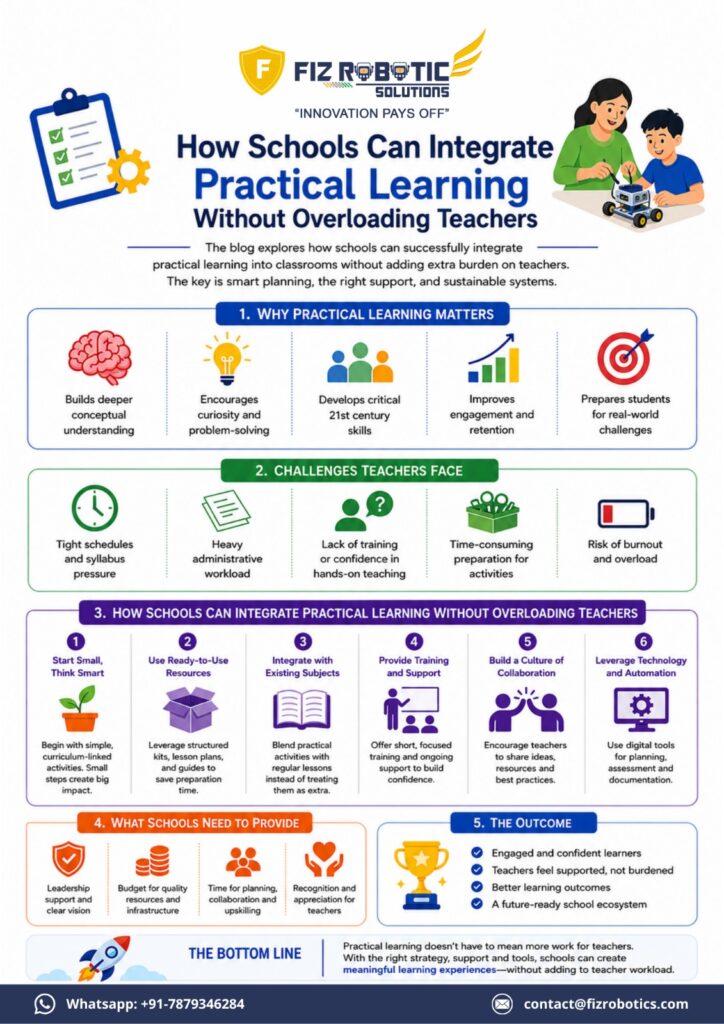
One of the most effective strategies is curriculum integration rather than curriculum addition. Practical learning should not be treated as an extra subject or activity. Instead, it should be embedded within existing subjects. For example, a science lesson on electricity can naturally include a simple circuit-building activity, while mathematics concepts can be reinforced through measurements and calculations in engineering-based projects. This approach ensures that teachers are not required to allocate additional time, but rather enhance the quality of the time already available.
Another key aspect is the use of structured modules and ready-to-use resources. Teachers often face challenges when they are expected to design practical sessions from scratch. Providing well-designed lesson plans, step-by-step project guides, and pre-assembled kits can significantly reduce preparation time. When resources are standardized and aligned with learning objectives, teachers can focus more on facilitating learning rather than planning logistics. This not only improves efficiency but also ensures consistency in delivery across classrooms.
Teacher training and support systems also play a crucial role. Instead of expecting teachers to independently adapt to new methodologies, schools must invest in continuous professional development. Short, focused training sessions can help educators understand how to manage practical classrooms, integrate projects seamlessly, and guide student inquiry effectively. Additionally, ongoing support—such as access to mentors or instructional guides—can build confidence among teachers and reduce the perceived burden of implementing hands-on learning.
Time management within the classroom can further ease the process. Practical learning does not always require extended lab sessions. Micro-activities—short, focused tasks that demonstrate a concept—can be equally impactful. For instance, a 10–15 minute activity using basic components can effectively reinforce a concept without disrupting the lesson schedule. Over time, these small interventions accumulate into a strong foundation of experiential learning without overwhelming teachers or students.
Collaboration is another powerful tool. Schools can encourage team-based teaching approaches, where responsibilities are shared among educators. For example, STEM coordinators or specialized instructors can support subject teachers in conducting practical sessions. This collaborative model ensures that no single teacher bears the entire responsibility, while also promoting a more dynamic and engaging learning environment for students.
Technology can also act as an enabler rather than an additional burden. Digital platforms that offer simulations, guided instructions, and assessment tools can simplify the execution of practical learning. These tools allow teachers to monitor progress, provide feedback, and manage classroom activities more efficiently. When used effectively, technology reduces manual effort and enhances the overall teaching-learning experience.
At FRS, we understand the challenges schools and educators face in implementing practical learning. Our approach is designed to simplify integration while maximizing impact. We provide structured STEM modules, hands-on kits, and comprehensive teacher training that align seamlessly with school curricula. By equipping educators with ready-to-use resources and continuous support, we ensure that practical learning becomes a natural part of classroom teaching—without adding to the workload.
Our programs are specifically designed to empower teachers, not burden them. By focusing on concept-driven learning, easy implementation strategies, and scalable solutions, we help schools create an engaging STEM environment where students actively learn by doing, and teachers confidently facilitate the process.
In conclusion, integrating practical learning in schools does not require additional pressure on teachers—it requires thoughtful planning, the right resources, and effective support systems. By embedding hands-on activities into existing curricula, leveraging structured solutions, and fostering collaboration, schools can create a balanced approach that benefits both educators and students. With the right partners and strategies in place, practical learning can become not just manageable, but transformative.