
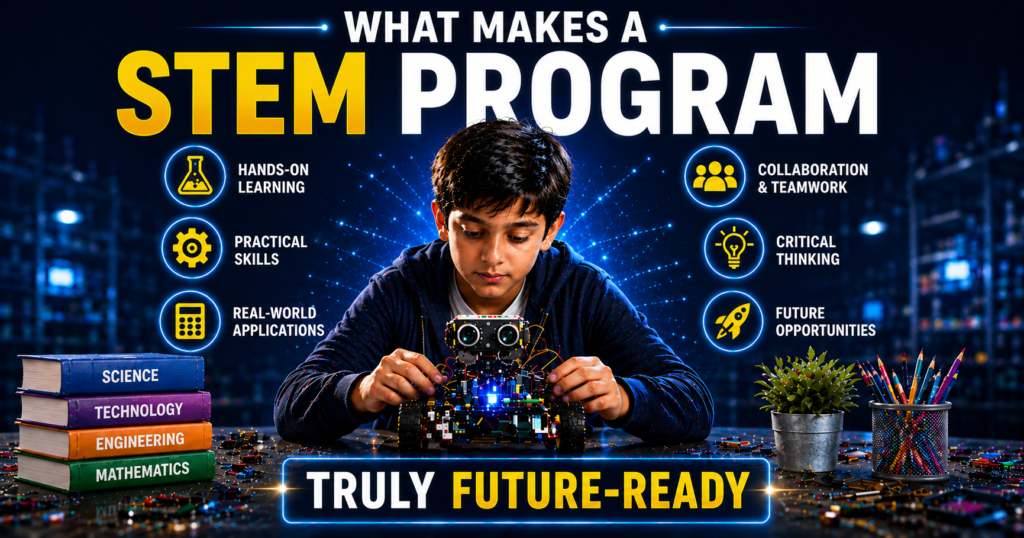
In an era defined by rapid technological advancement and constant innovation, the concept of a “future-ready” STEM program has become central to modern education. Schools across the globe are investing in laboratories, robotics kits, and digital tools to align with this vision. However, simply introducing technology into classrooms does not guarantee meaningful learning. A truly future-ready STEM program goes beyond infrastructure—it is defined by its ability to build deep understanding, adaptability, and real-world problem-solving skills among students.
At the heart of any effective STEM program lies conceptual clarity. Students must not only engage with tools but also understand the principles behind them. Whether it is robotics, electronics, or coding, the focus should be on how systems function. For instance, while assembling a robot is a valuable activity, understanding how sensors communicate with microcontrollers or how algorithms control movement is what transforms the experience into true learning. This depth of knowledge enables students to think critically and apply concepts across different contexts.
Another essential component is experiential and project-based learning. Future-ready programs prioritize hands-on experiences where students actively build, test, and refine their ideas. Projects such as designing smart automation systems, creating robotic prototypes, or developing simple AI-based solutions allow learners to bridge the gap between theory and application. These activities foster creativity, collaboration, and analytical thinking—skills that are indispensable in real-world scenarios. Importantly, such projects also encourage students to embrace failure as a part of the learning process, cultivating resilience and innovation.
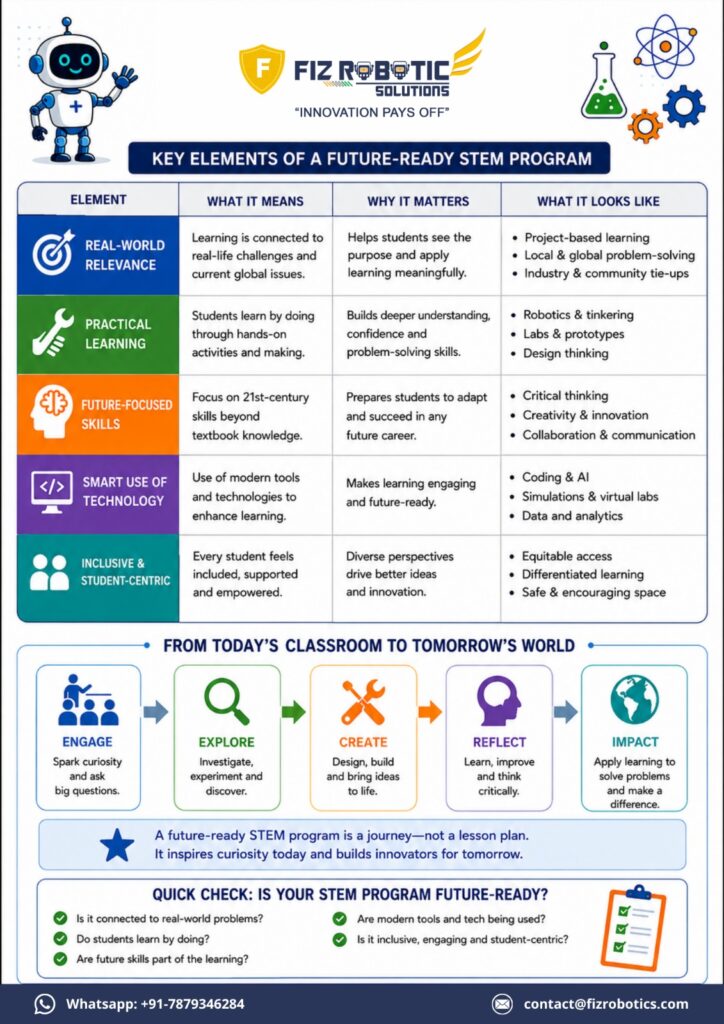
Equally important is the role of educators. Teachers in a future-ready STEM environment must transition from traditional instructors to facilitators of learning. Their role is not limited to demonstrating procedures but extends to guiding inquiry, encouraging exploration, and nurturing curiosity. By asking the right questions and creating problem-solving environments, teachers empower students to think independently. Continuous teacher training and upskilling are therefore critical to ensure that educators remain aligned with evolving technologies and pedagogical approaches.
A future-ready STEM program must also emphasize interdisciplinary learning. Real-world challenges rarely exist within the boundaries of a single subject. Integrating science, technology, engineering, and mathematics allows students to approach problems holistically. For example, a robotics project may involve principles of physics, coding logic, mathematical calculations, and design thinking. This integrated approach not only enhances understanding but also prepares students for complex, multifaceted challenges in their future careers.
In addition, adaptability and future skills are key indicators of a strong STEM program. Technology is constantly evolving, and students must be equipped with skills that remain relevant despite these changes. Critical thinking, problem-solving, creativity, communication, and digital literacy are among the core competencies that define future readiness. Programs that focus solely on specific tools risk becoming outdated, whereas those that emphasize foundational concepts and transferable skills ensure long-term relevance.
At FRS, we are committed to building STEM programs that truly prepare students for the future. Our approach is rooted in experiential learning, where students are encouraged to explore the “why” behind every concept. Through carefully designed modules in robotics, electronics, and emerging technologies, we create an environment where learners actively engage with ideas rather than passively follow instructions. We also work closely with educators, equipping them with structured methodologies and training that enable effective delivery of concept-driven STEM education.
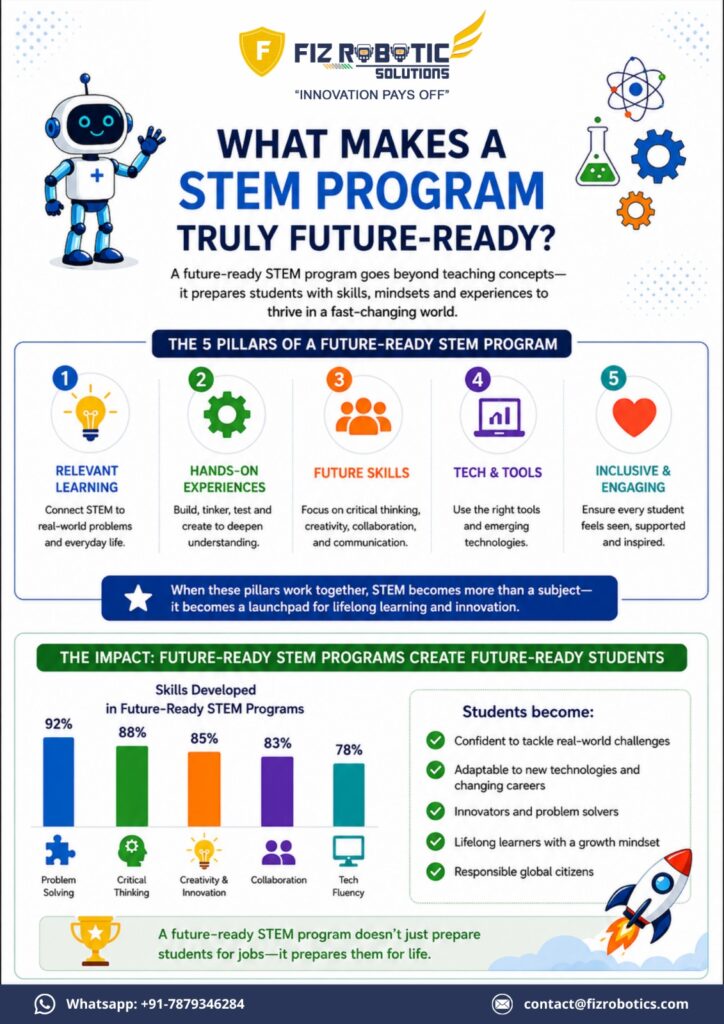
Our programs are designed to be scalable, practical, and aligned with real-world applications. By integrating hands-on projects with strong theoretical foundations, we ensure that students develop both technical knowledge and essential life skills. This holistic approach not only enhances academic learning but also builds confidence, independence, and a problem-solving mindset among students.
In conclusion, a truly future-ready STEM program is not defined by the tools it uses, but by the mindset it cultivates. It is one that prioritizes understanding over memorization, application over instruction, and innovation over imitation. By focusing on conceptual clarity, experiential learning, teacher empowerment, and skill development, such programs prepare students to navigate and shape the future.