
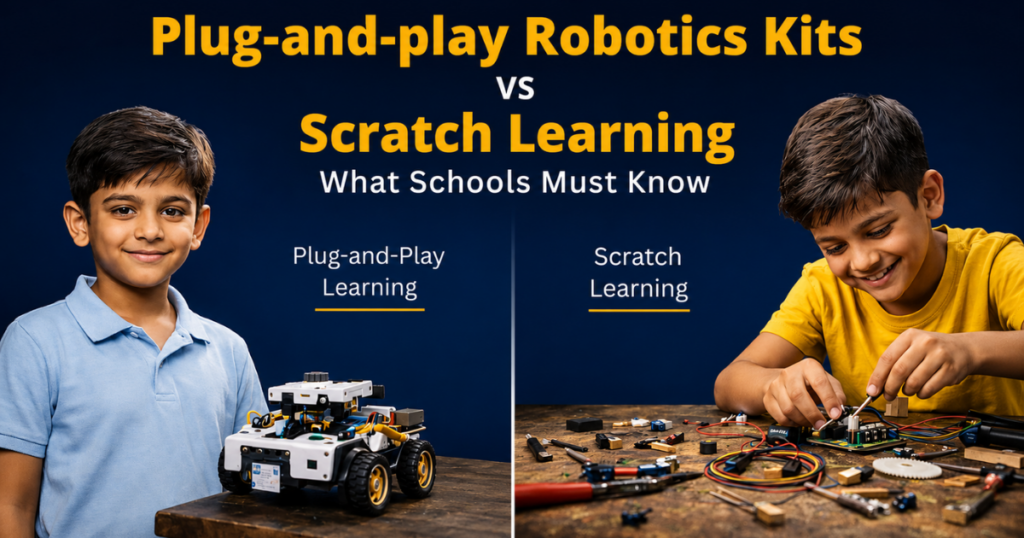
Robotics and AI labs are becoming common in schools. Colorful kits, quick demos, and instant results look impressive. But behind the excitement, an important question remains unanswered:
Are students actually learning—or just assembling?
As schools aim to prepare students for the future, understanding the difference between plug-and-play robotics kits and scratch-based learning has never been more important.
The Rise of Plug-and-Play Robotics Kits
Plug-and-play kits promise quick outcomes:
- Pre-designed components
- Fixed instructions
- Guaranteed results
Within minutes, a robot moves, lights blink, and students feel accomplished. For short-term engagement, this works well.
But here’s the reality schools must consider:
Plug-and-play teaches execution, not understanding.
Students follow steps, not logic. Once the kit is packed away, the learning often ends there.
The Hidden Limitation of Plug-and-Play Learning
While plug-and-play kits look advanced, they quietly limit a student’s growth:
- No deep understanding of electronics or mechanics
- No exposure to raw components
- Minimal problem-solving or debugging
- Dependency on predefined designs
Students learn what to connect, not why it works. When something goes wrong outside the instruction manual, they struggle.
In an industry-driven world, this approach creates users of technology, not creators of technology.
Scratch Learning: Where Real Thinking Begins
Scratch learning is fundamentally different.
Instead of starting with ready-made solutions, students begin with:
- Basic electronic components
- Core mechanical concepts
- Logical thinking and experimentation
- Trial, error, and improvement
They learn how sensors behave, how circuits are formed, how motors respond, and how systems interact.
This process may look slower—but it builds stronger, long-lasting intelligence.
Why Industry Prefers Scratch Learners
Industries in 2026 are not looking for students who can assemble kits. They are looking for individuals who can:
- Understand systems
- Diagnose problems
- Innovate under constraints
- Adapt to new technologies
Scratch learners develop:
- Critical thinking
- Engineering mindset
- Confidence to experiment
- Ability to learn independently
These are the exact skills automation and AI cannot replace.
What Schools Must Ask Themselves
Before choosing a robotics or AI program, schools should ask:
- Are students learning concepts or just following steps?
- Can students build something without a manual?
- Are they encouraged to fail, fix, and improve?
- Is the learning scalable across grades?
The answers to these questions define whether a school is building future-ready students or just offering a trendy activity.
How FIZ Robotic Solutions (FRS) Takes a Different Path
At FIZ Robotic Solutions (FRS), the belief is simple:
True learning begins from scratch.
FRS programs are designed to:
- Teach students using raw materials and basic components
- Build strong foundations in electronics, robotics, AI, and aeromodelling
- Move beyond plug-and-play dependency
- Encourage curiosity, creativity, and real problem-solving
From early grades to senior classes, FRS follows a progressive, age-appropriate learning model, ensuring students grow step by step—conceptually and practically.
Students don’t just assemble robots; they understand how and why robots work.
The Long-Term Impact on Students
Scratch-based learners:
- Perform better in higher education
- Adapt faster to new technologies
- Show stronger analytical skills
- Develop innovation-driven thinking
Most importantly, they don’t fear complexity—they embrace it.
Final Thought: Choose Depth Over Display
Robotics education should not be about quick results and flashy demos. It should be about building minds that can think, design, and innovate.
Plug-and-play may impress today.
Scratch learning prepares students for tomorrow.
And schools that understand this difference are the ones truly shaping the future—with FIZ Robotic Solutions as their partner in meaningful, future-ready education.