
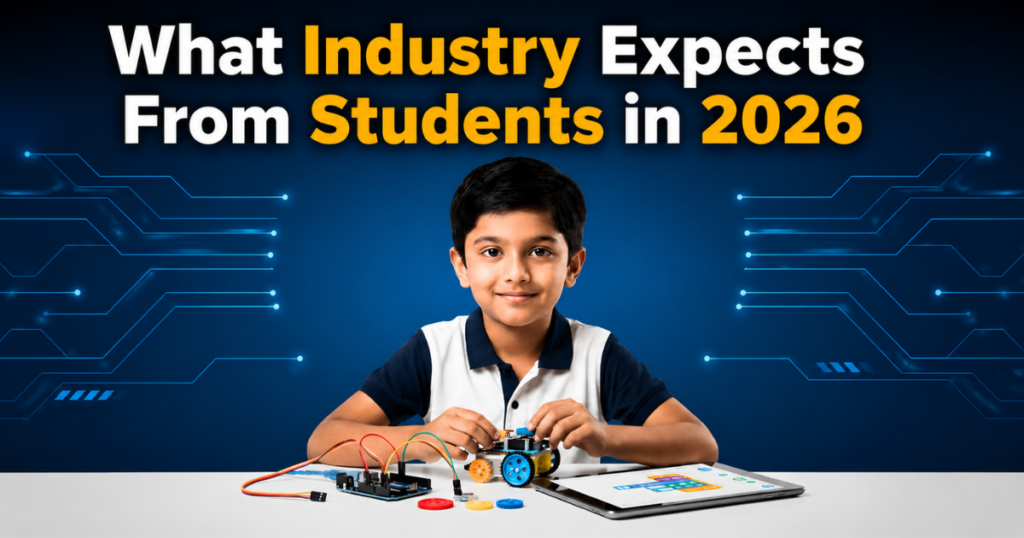
The world of work is changing faster than ever before. By 2026, industries will not just look at marksheets and degrees—they will look for skills, adaptability, and real-world problem-solving ability. For parents, teachers, and school leaders, this shift brings an important question: Are today’s students truly ready for tomorrow’s industry?
The answer lies in how early and how effectively students are exposed to future-ready skills.
The New Expectations of Industry in 2026
Modern industries—whether in technology, manufacturing, healthcare, or automation—are aligned around a few core expectations:
1. Strong Conceptual Foundations
Industries no longer want students who simply “know how to use tools.” They want individuals who understand how things work—from basic electronics and mechanics to logic, mathematics, and computational thinking.
A student who understands why a circuit works will always outperform one who has only assembled ready-made kits.
2. Problem-Solving & Critical Thinking
In 2026, repetitive jobs will increasingly be handled by automation. What will remain valuable is the human ability to:
- Analyze problems
- Break them into smaller parts
- Design logical solutions
- Test, fail, and improve
These skills cannot be developed overnight or taught only through textbooks.
3. Hands-On Technical Exposure
Industries expect students to be comfortable working with real components, not just simulations. Exposure to robotics, electronics, aeromodelling, and AI from an early age builds confidence and practical intelligence.
Students who have built, wired, tested, and debugged things think very differently from those who have only memorized concepts.
4. Adaptability to Emerging Technologies
AI, robotics, automation, and smart systems are no longer “future technologies”—they are already here. The industry expects students to:
- Be technology-aware
- Learn continuously
- Adapt quickly to new tools and systems
This adaptability starts in school, not college.
The Gap in Traditional Education
Most traditional education systems still focus heavily on:
- Rote learning
- Exam-centric teaching
- Theoretical knowledge
While these have their place, they often fail to develop industry-relevant skills. Many students reach higher classes without ever understanding how machines, electronics, or intelligent systems actually work.
This is where a structured, future-oriented approach becomes essential.
How FIZ Robotic Solutions (FRS) Is Bridging the Gap
At FIZ Robotic Solutions (FRS), the focus is clear: build students from the ground up—conceptually, practically, and creatively.
Learning From Scratch, Not Plug-and-Play
Unlike programs that rely only on plug-and-play kits, FRS emphasizes:
- Raw materials and basic components
- Core concepts of electronics, robotics, AI, and aeromodelling
- Understanding systems before assembling them
This approach ensures students don’t just use technology—they understand it.
Age-Appropriate Skill Development
FRS designs structured learning paths for all classes, ensuring:
- Younger students develop curiosity, logic, and creativity
- Middle-grade students build strong technical foundations
- Senior students gain advanced exposure to robotics, AI, and real-world applications
Each stage prepares students for the next, making learning continuous and meaningful.
Industry-Aligned Curriculum
FRS programs are aligned with what industries actually expect:
- Logical thinking
- Hands-on project execution
- Teamwork and innovation
- Confidence in working with technology
Students don’t just learn—they build, experiment, and innovate.
Why This Matters for Schools and Parents
Schools that invest in future-ready education today will produce:
- Confident learners
- Skilled problem solvers
- Students prepared for competitive careers
Parents, teachers, and education leaders all share one goal: to see students succeed not just in exams, but in life.
Preparing Students for 2026—Starting Today
The industry of 2026 will belong to those who can think, build, and adapt. With its strong foundation-based approach, FIZ Robotic Solutions is empowering students across classes to upgrade their skills and mindset—long before they step into the professional world.
Because the future doesn’t wait—and education shouldn’t either.