
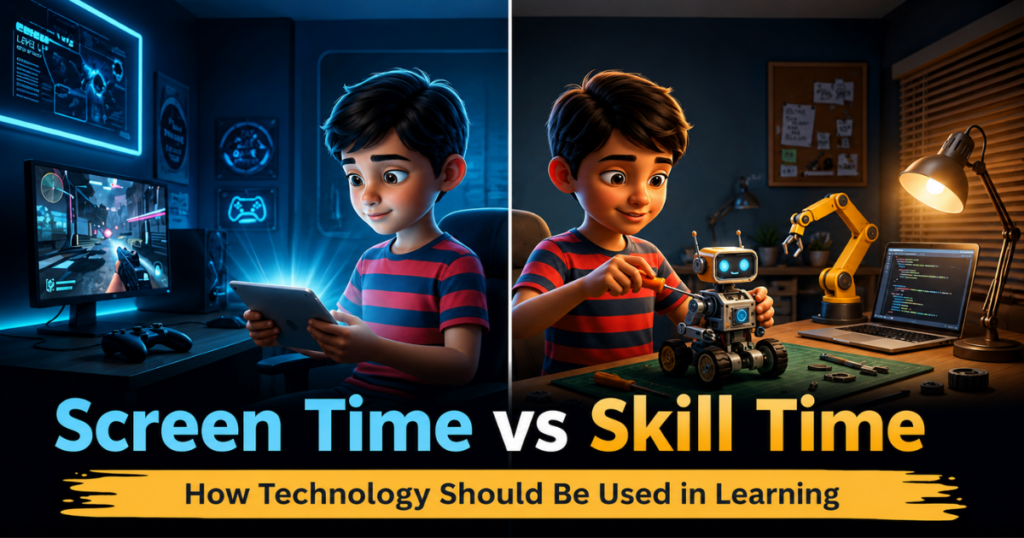
Today’s students are surrounded by screens. From online classes and educational apps to videos and games, technology has become an inseparable part of childhood. While digital tools have made information more accessible, they have also raised an important concern for parents and schools alike: Are students truly learning, or just spending more time in front of screens?
This is where the difference between screen time and skill time becomes critical.
Screen time is largely passive. Students watch, swipe, click, and consume content. Even when the content is educational, the student often remains a viewer rather than a thinker. Over time, excessive screen-based learning can reduce attention span, limit creativity, and create dependency on instructions rather than understanding.
Skill time, on the other hand, is active. It involves thinking, building, experimenting, and problem-solving. Technology becomes a tool, not a distraction. Instead of asking students to simply look at a screen, skill-based learning asks them to use technology to create something meaningful.
The goal of modern education should not be to eliminate technology, but to use it wisely.
NEP 2020 clearly emphasizes experiential and hands-on learning. It encourages schools to move beyond content consumption and focus on practical understanding, logical reasoning, and real-world application of knowledge. This vision cannot be achieved through screens alone.
True learning happens when students apply concepts. When they build a circuit, program a robot, test a solution, and correct mistakes, they are not just learning technology—they are learning how to think. Screens may support learning, but skills are developed only through action.
Unfortunately, many classrooms still equate digital learning with progress. Smart boards, tablets, and videos are introduced, but students remain passive recipients of information. Technology becomes a replacement for textbooks, not a gateway to deeper learning.
This is where hands-on STEM and robotics education plays a crucial role.
In a well-designed robotics lab, screens are used purposefully. Students write code, observe outputs, analyze errors, and refine their solutions. The screen supports the process, but the learning happens through experimentation, discussion, and problem-solving. This balance transforms screen time into skill time.
At FIZ Robotic Solutions (FRS), we strongly believe that technology should empower students—not distract them. Our robotics and STEM programs are designed to reduce passive screen exposure and increase active engagement.
Students don’t just watch simulations; they build real systems. They don’t memorize steps; they understand concepts. Technology becomes a medium through which creativity, logic, and innovation are developed.
Our experiential robotics labs help schools create environments where students learn by doing. With a concept-first approach, structured hands-on activities, and guided exploration, students gain confidence in using technology to solve problems rather than simply consume content.
For parents, this approach ensures that technology time is meaningful and productive. For students, it builds essential skills like critical thinking, collaboration, and problem-solving. For schools, it aligns perfectly with NEP 2020 and creates a future-ready learning ecosystem.
The real question is no longer how much screen time students have, but how that time is used.
When technology is used only for viewing, learning remains limited. When it is used for creating, experimenting, and solving, it becomes a powerful educational tool.
With FIZ Robotic Solutions (FRS), schools can strike the right balance—turning screen time into skill time and preparing students not just for exams, but for life.
Because technology should not raise passive users—it should build capable creators.