
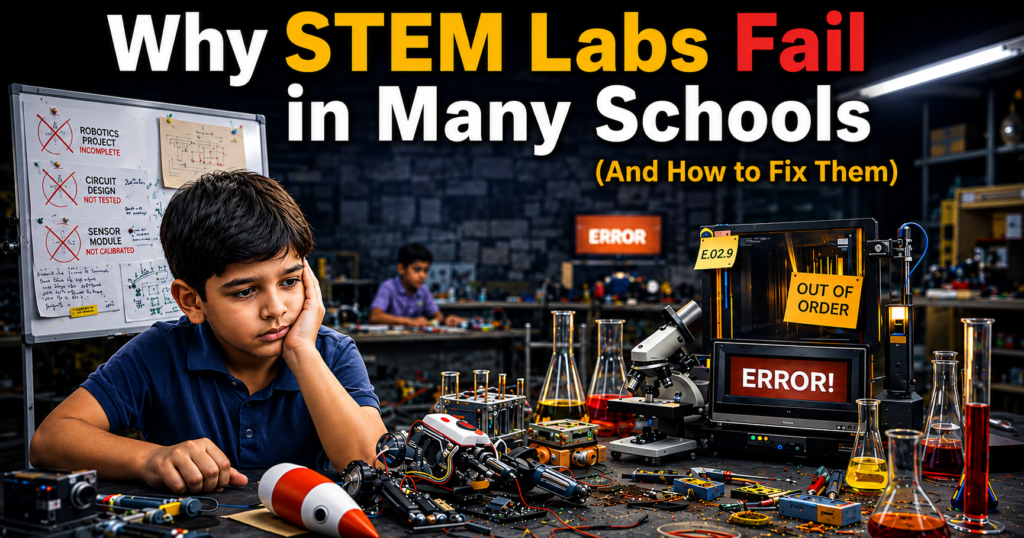
Walk into a modern school today, and you’ll likely find a STEM lab filled with robotics kits, wires, sensors, and exciting-looking projects. At first glance, it feels like education is moving in the right direction.
But spend a little more time there, and a different picture often emerges.
Ask a student, “How does this robot work?”—and you may be met with silence or a very unclear answer.
That’s where the real problem begins.
Where Things Start Going Wrong
The idea behind introducing STEM labs is excellent. Schools want students to experience robotics, innovation, and technology firsthand. Parents want their children to be future-ready.
But in many cases, the learning becomes limited to following instructions.
Students are guided step-by-step:
Connect this wire. Upload this code. Press this button.
The project works. The task is completed.
But the understanding? That often remains incomplete.
Over time, students get used to “doing” without truly “thinking.” And that’s exactly why many STEM labs fail to deliver real impact.
Why This Should Concern Schools and Parents
For parents, it raises an important concern:
Is my child actually learning something valuable, or just staying busy?
For school owners, it becomes a bigger question:
Are we creating a meaningful learning experience, or just showcasing infrastructure?
Because in today’s world, exposure alone is not enough.
We are living in a time defined by rapid advancements in technology and robotics. The goal is no longer to produce students who can follow instructions—it’s to nurture those who can think independently and create solutions.
What Real STEM Learning Looks Like
A good STEM lab doesn’t just produce working models—it builds thinking minds.
Students should feel confident enough to:
- Explain what they built and how it works
- Experiment with new ideas
- Fix mistakes without fear
- Improve or redesign their projects
That’s where real innovation begins.
When students move beyond instructions and start asking questions like “What if I try this differently?”, learning becomes meaningful.
And that’s exactly what defines the new era of robotics—not just building machines, but understanding and improving them.
So, What Needs to Change?
The issue isn’t about having fewer resources or outdated tools. In fact, many schools already have well-equipped labs.
The real shift needs to happen in the approach.
STEM education should focus on:
- Building strong concepts before jumping into projects
- Encouraging curiosity instead of just completion
- Adapting to different learning speeds
- Connecting classroom knowledge to real-world applications
Most importantly, students need the right guidance—someone who doesn’t just tell them what to do, but helps them understand why they’re doing it.
The Role of the Right Partner
This is where having the right support system becomes crucial.
FRS works with a clear purpose—to ensure that STEM learning is not reduced to a checklist activity.
Instead of focusing only on building projects, FRS emphasizes understanding, exploration, and creativity. The goal is simple: every student should not just complete a project, but truly learn from it.
With structured programs, hands-on learning, and continuous mentorship, FRS helps schools turn their STEM labs into spaces where real learning happens.
Moving Towards Meaningful Learning
For schools, this is an opportunity to go beyond infrastructure and create genuine impact.
For parents, it offers reassurance that their child is developing skills that truly matter.
And for students, it opens the door to something powerful—the ability to think, create, and innovate.