
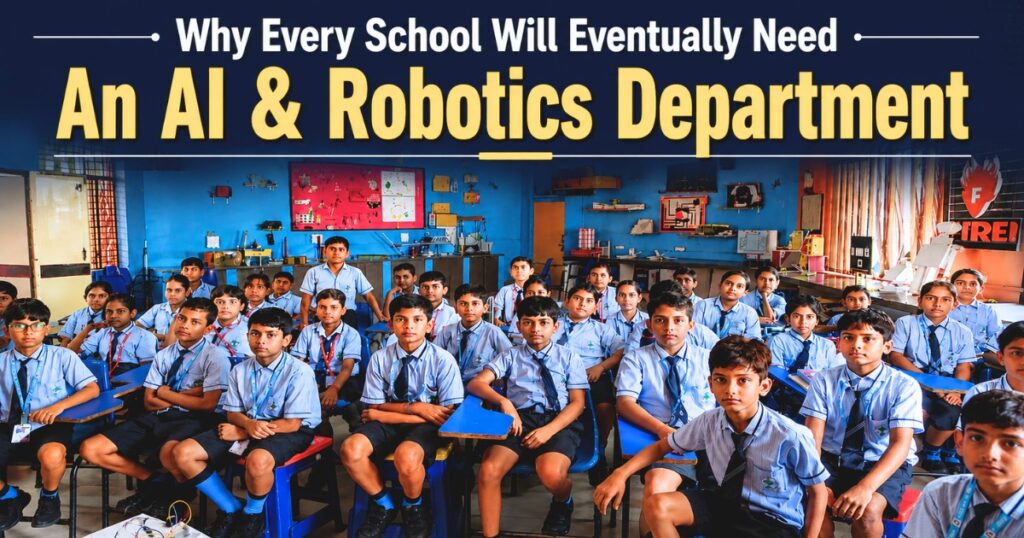
For years, schools have focused on building strong academic foundations through subjects like Mathematics, Science, Languages, and Social Studies. These subjects will always remain important.
But the world students are preparing to enter is changing faster than ever before.
- Artificial Intelligence is reshaping industries.
- Automation is transforming workplaces.
- Technology is influencing nearly every profession — from healthcare and agriculture to design, transportation, finance, and manufacturing.
The question schools now face is no longer:
“Should students learn technology?”
The real question is:
“How early should students start understanding the technologies shaping their future?”
Over the next decade, AI & Robotics Departments may become as essential to schools as Science Labs and Computer Labs once became.
Not because robotics is a trend.
But because innovation-driven learning is becoming a necessity.
1. The Future Workforce Will Be Deeply Connected With Technology
Today’s students are entering a world where:
- AI tools are automating repetitive tasks,
- machines are assisting human decision-making,
- and smart systems are becoming part of daily life.
Even professions that traditionally had little connection with technology are rapidly evolving.
For example:
- Farmers now use smart sensors and drones.
- Doctors use AI-assisted diagnostics.
- Architects use automation and simulation tools.
- Businesses rely heavily on data and AI systems.
Schools that expose students early to these concepts may help them adapt more confidently to future industries.
2. Robotics Teaches More Than Technology
One of the biggest misconceptions about robotics education is that it is only about building robots.
In reality, robotics teaches students how to think.
A robotics activity often requires students to:
1. Identify a problem
2. Design a solution
3. Test their idea
4. Fail and improve
5. Present the final outcome
This process mirrors real-world innovation far more closely than memorization-based learning.
3. AI & Robotics Departments Will Encourage Practical Learning
Traditional classrooms often focus heavily on theoretical understanding.
However, students usually learn concepts more deeply when they physically interact with them.
For example:
- Sensors help students understand automation.
- Electronics projects explain real circuit behavior.
- AI-based activities introduce logical reasoning.
- Coding projects improve structured thinking.
This is why future-focused schools are increasingly moving toward experiential learning ecosystems instead of purely textbook-driven education.
4. Schools Will Need Dedicated Innovation Ecosystems
In the future, occasional workshops may no longer be enough.
An AI & Robotics Department is not just a room filled with devices.
A properly designed department includes:
- structured curriculum,
- practical learning models,
- innovation-driven activities,
- mentor guidance,
- project-based learning,
- and exposure to future technologies.
It becomes a culture-building space inside the school.
5. Students Need to Become Creators, Not Just Consumers
Today’s generation spends significant time using technology:
- smartphones,
- applications,
- gaming platforms,
- social media,
- and AI tools.
But the future may belong to students who can create technology, not only consume it.
Schools have an important opportunity to help students move from:
passive usage,
to:
active innovation.
When students build:
- automation systems,
- smart models,
- robotics projects,
- AI-based concepts,
- or problem-solving prototypes,
they begin understanding technology at a much deeper level.
That shift can completely change their confidence and career perspective.
6. AI Will Increase the Value of Human Creativity
As AI systems become more powerful, purely repetitive knowledge-based tasks may become increasingly automated.
Ironically, the rise of AI may make human creativity more important than ever before.
Schools that successfully combine:
technology education,
with:
creative thinking,
may prepare students more effectively for the future.
7. Innovation Exposure Builds Confidence Early
Many students discover their interests only after school — sometimes too late.
In many cases, students who struggle with traditional learning methods perform exceptionally well during hands-on activities.
This is because practical environments often unlock abilities that standard classrooms may not fully reveal.
8. Schools Will Be Evaluated Differently in the Future
In the coming years, parents may increasingly look beyond:
- infrastructure,
- board results,
- and classroom facilities.
They may begin asking:
- Does the school encourage innovation?
- Are students getting practical exposure?
- Is the school preparing students for future industries?
- Are students learning problem-solving skills?
Schools that invest early in future-focused learning ecosystems may stand out significantly.
9. AI & Robotics Education Should Be Structured, Not Superficial
Simply purchasing robotics kits or conducting one-time activities is not enough.
This is where experienced organizations like FIZ Robotic Solutions help schools create complete innovation ecosystems instead of isolated technology activities.
By integrating:
- Robotics,
- AI,
- Electronics,
- IoT,
- Coding,
- Aeromodelling,
- and experiential learning,
schools can create environments where students learn by building, experimenting, and innovating.
Education is entering one of the most important transformation phases in history.
The future may not reward students simply for memorizing information.
AI & Robotics Departments are not only about technology infrastructure.
They represent a shift toward future-ready education.
And eventually, schools that embrace this shift early may become the institutions that shape the next generation of thinkers, creators, innovators, and leaders.